
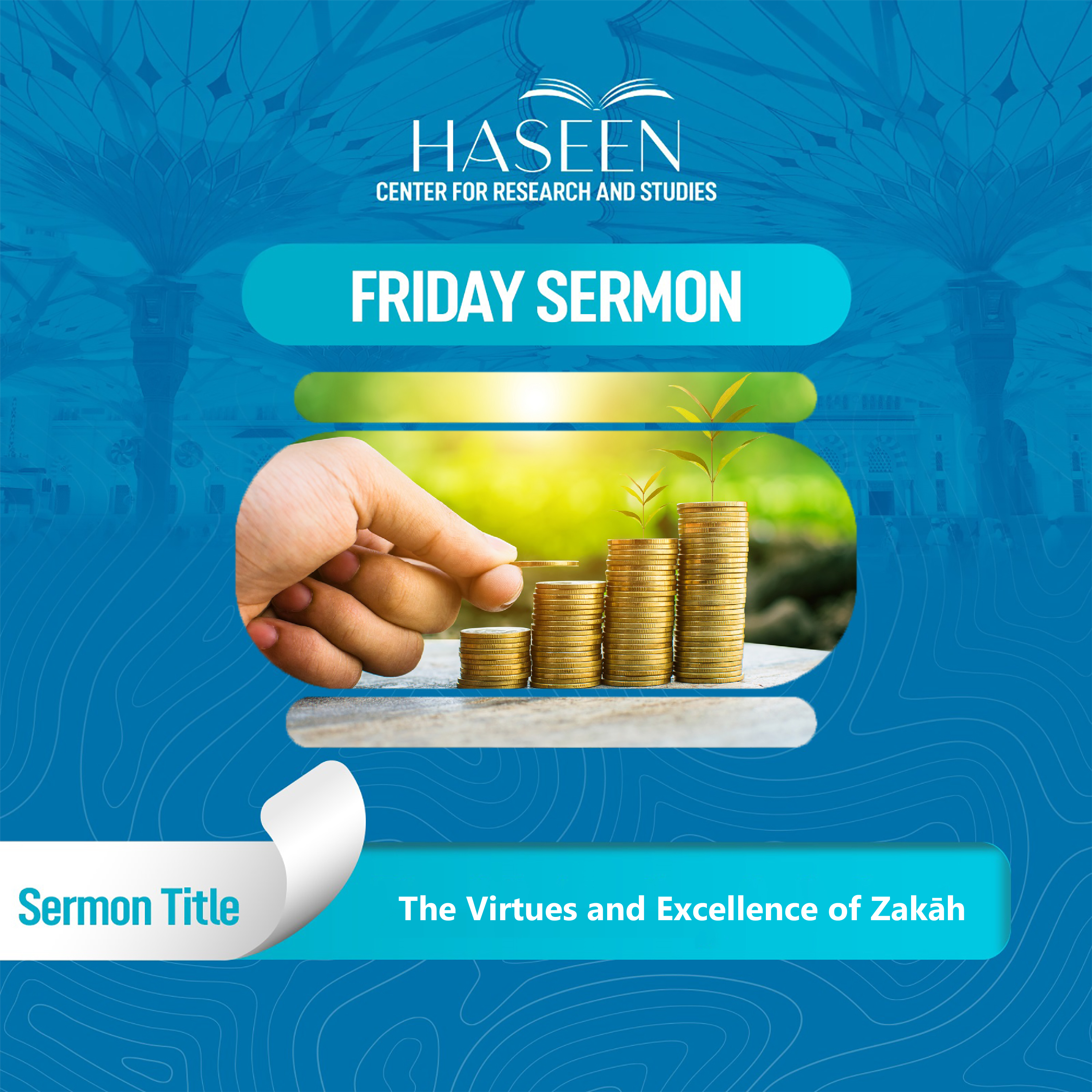
Sermon's Title: The Virtues and Excellence of Zakāh
Themes of the Sermon:
1- The status of Zakāh in Islam.
2- The virtues of Zakāh in its legislation, purpose, and outcomes.
3- Zakāh as a complete and integrated system.
All praise is due to Allah, the Most Merciful, the Most Compassionate. He has legislated for His servants the upright religion and made it a means for the well-being of both worldly life and faith. I bear witness that there is no deity worthy of worship except Allah alone, with no partner, and I bear witness that Muḥammad is His servant and His Messenger. May Allah send abundant peace and blessings upon him.
To proceed: Fear Allah, O servants of Allah, with true God-consciousness, and be mindful of Him in private and in public. Allah the Exalted says:
يَا أَيُّهَا الَّذِينَ آمَنُوا اتَّقُوا اللَّهَ حَقَّ تُقَاتِهِ وَلَا تَمُوتُنَّ إِلَّا وَأَنْتُمْ مُسْلِمُونَ
“O you who believe, fear Allah as He should be feared, and do not die except in a state of submission.” [Sūrat Āl ʿImrān: 102]
O servants of Allah,
One day, the Prophet ﷺ narrated to his Companions the story of three men from the Children of Israel: one afflicted with leprosy, one bald, and one blind. Allah willed to test them, so He changed their condition—granting them health after illness and wealth after poverty. Then He tested them again by sending to them an angel in the form of a poor man whose means had been cut off, asking each of them for a small portion of their wealth to help him reach his family.
As for the bald man and the leper, they responded with stinginess and denial, saying, “There are many claims upon my wealth.” But the blind man thanked Allah for His blessing and did not withhold the wealth of Allah. The outcome was that the two ungrateful men earned the anger and punishment of Allah, while the grateful one received blessing and Allah’s pleasure. The full story is recorded in the two authentic collections.
O servants of Allah,
This story is repeated every day in the lives of people. By His wisdom, Allah expands provision for some of His servants, making them wealthy, and restricts provision for others, making them poor. All of this is a test from Him—exalted is He—for both the rich and the poor.
Part of Allah’s test for the wealthy is that He has made Zakāh obligatory upon their wealth. He made it a right for the poor, not a favor from the rich, and He legislated Zakāh as a system of remarkable precision—one that, if the Ummah were to establish it as Allah intended, would spread goodness and peace throughout society.
Allah, the All-Wise and All-Knowing, placed within His law the means to a wholesome and upright life, by which misguidance, hardship, and misery are removed. No one fully comprehends the secrets of His law and the beauty of His religion except Him. Yet we are now given the opportunity to reflect upon some of the wisdom, secrets, and beauty of the obligation of Zakāh.
Zakāh, in Islamic law, is a binding obligation that Allah has imposed upon the wealth of the rich, to be distributed to specific categories defined by the Sharīʿah. He has set for every type of wealth a minimum threshold (niṣāb) that must be reached before Zakāh becomes due, and He has also determined the time when it must be paid.
Linguistically, the word Zakāh in Arabic means growth and purification. This meaning is clearly reflected in Zakāh itself: it causes wealth to grow and purifies it.
Zakāh is one of the pillars of Islam and one of its great foundations. Allah commanded it in His Book and repeatedly linked it with Ṣalāh (the prescribed prayer). He made it among the defining qualities of the believers, saying:
وَالَّذِينَ هُمْ لِلزَّكَاةِ فَاعِلُونَ
“And those who give Zakāh.” [Sūrat al-Muʾminūn: 4]
The Prophet ﷺ said: “Islam is built upon five: the testimony that there is no deity worthy of worship except Allah and that Muḥammad is the Messenger of Allah, establishing prayer, giving Zakāh, performing Ḥajj, and fasting Ramaḍān.” Narrated by al-Bukhārī and Muslim.
Allah even described one of the earliest traits of the polytheists as their refusal to give Zakāh. He says:
وَوَيْلٌ لِلْمُشْرِكِينَ * الَّذِينَ لَا يُؤْتُونَ الزَّكَاةَ وَهُمْ بِالْآخِرَةِ هُمْ كَافِرُونَ
“And woe to the polytheists—those who do not give Zakāh, and in the Hereafter they are disbelievers.” [Sūrat Fuṣṣilat: 6–7]
They are those who neither acknowledge its obligation nor deliver it to those entitled to it. Zakāh is a bridge of Islam: whoever crosses it is saved, and whoever turns away from it is ruined.
Zakāh is part of Allah’s perfect and just law—a law that is entirely good and benevolent in its legislation, intent, purpose, and outcome.
The first and greatest of its virtues is that it represents a declaration of Islam and complete submission by the believer to the command of his Lord in all aspects of life, including wealth. Many nations before were destroyed because they rejected Allah’s command concerning their wealth. Islam is to be taken in its entirety, without selective acceptance. The One who commanded Tawḥīd (affirming Allah’s oneness) and Ṣalāh is the same One who commanded Zakāh. This is the upright religion, in which there is no deviation. Allah says:
وَمَا أُمِرُوا إِلَّا لِيَعْبُدُوا اللَّهَ مُخْلِصِينَ لَهُ الدِّينَ حُنَفَاءَ وَيُقِيمُوا الصَّلَاةَ وَيُؤْتُوا الزَّكَاةَ وَذَلِكَ دِينُ الْقَيِّمَةِ
“And they were not commanded except to worship Allah, sincere to Him in religion, inclining to truth, and to establish prayer and give Zakāh. That is the upright religion.” [Sūrat al-Bayyinah: 5]
Among the beauties of Zakāh’s legislation is that Allah did not make it obligatory on everything a Muslim owns. Rather, He obligated it only on wealth that is capable of growth and increase. He did not obligate Zakāh on personal items used in daily life, such as one’s home, vehicle, furniture, and the like.
Another virtue of its legislation is justice and gentleness. Allah knows how much people love wealth and cling to it. Therefore, He did not command them to give all of it, nor half of it, nor even a quarter of it. Instead, He required only a very small portion—often between one-tenth and one-fortieth (a quarter of a tenth), depending on the effort and cost involved in acquiring that wealth. Allah says:
وَلَا يَسْأَلْكُمْ أَمْوَالَكُمْ * إِنْ يَسْأَلْكُمُوهَا فَيُحْفِكُمْ تَبْخَلُوا وَيُخْرِجْ أَضْغَانَكُمْ
“And He does not ask you for your wealth. If He were to ask you for it insistently, you would withhold it, and He would expose what is within your hearts.” [Sūrat Muḥammad: 36–37]
Likewise, Allah did not obligate the giver to give the finest and best of his wealth. Rather, He accepted what is average, and forbade giving defective or inferior property, because Allah is Pure and accepts only what is pure, and because Zakāh is meant to console and support the poor.
For this reason, the Prophet ﷺ advised Muʿādh ibn Jabal when he sent him to Yemen. Among what he said was: “Inform them that Allah has made Zakāh obligatory upon them, to be taken from their rich and returned to their poor. If they acknowledge that, then take it from them, but beware of taking the best of people’s wealth.” Narrated by al-Bukhārī and Muslim.
The Prophet ﷺ further clarified the justice of Islam in this matter, saying:
“Three things—whoever does them has tasted the sweetness of faith: that he worships Allah alone and affirms that there is no deity worthy of worship except Allah; that he gives the Zakāh of his wealth willingly and contentedly, giving it every year; and that he does not give what is old and decrepit, nor diseased (meaning mangy), nor sick, nor what is inferior and contemptible (that is, the poor and worthless kind of wealth), but rather from the average of your wealth. For Allah has not asked you for its best, nor has He commanded you to give its worst.” Narrated by Abū Dāwūd.
Moreover, the Sharīʿah did not make Zakāh obligatory every day or every month; rather, most forms of Zakāh are due only once each year. As for what comes forth from the earth of crops and fruits, its Zakāh is due on the day of harvest.
Likewise, the Sharīʿah did not obligate Zakāh on every amount of wealth. Rather, it established a minimum threshold (niṣāb) for certain types of wealth—an amount by which a person is considered well-off and financially sufficient.
The Prophet ﷺ said: “There is no Zakāh on less than five awāq of silver, no Zakāh on less than five camels, and no Zakāh on less than five awsuq.” Narrated by al-Bukhārī and Muslim. (The wasq is a measure used for grains and fruits, and it equals sixty sāʿ.)
Among the beauties of its legislation is the greatness of its objective, for its immense benefits return to the wealthy, the poor, and the entire society.
As for the benefits of Zakāh for the wealthy, Allah has made it a purification for the soul from destructive greed, and a purification for wealth from its impurities. Allah, exalted is He, says:
خُذْ مِنْ أَمْوَالِهِمْ صَدَقَةً تُطَهِّرُهُمْ وَتُزَكِّيهِمْ بِهَا
“Take from their wealth a charity by which you purify them and cause them to grow.” [Sūrat al-Tawbah: 103]
Greed is intense eagerness to acquire wealth by any means—lawful or unlawful—and to withhold it from spending, preventing its giving whether obligatory or recommended. It is among the worst traits, one that destroys both the individual and society. Hence, the Prophet ﷺ said: “Beware of greed, for greed destroyed those before you. It led them to shed blood and to deem unlawful matters permissible.” Narrated by Muslim.
How did greed drive them to that?
The Prophet ﷺ said: “Beware of greed, for those before you were destroyed by greed. It commanded them to be miserly, so they were miserly; it commanded them to sever ties, so they severed them; and it commanded them to commit immorality, so they committed immorality.” Narrated by Abū Dāwūd.
When the wealthy person submits to the command of his Lord and gives a portion of his wealth willingly and with a content heart, his soul is purified from miserliness, greed, and servitude to wealth.
In reality, Zakāh does not diminish wealth; rather, it brings blessing and growth. Allah has promised those who give the Zakāh of their wealth multiplied reward and recompense. He says:
وَمَا آتَيْتُمْ مِنْ زَكَاةٍ تُرِيدُونَ وَجْهَ اللَّهِ فَأُولَئِكَ هُمُ الْمُضْعِفُونَ
“And whatever you give in Zakāh, seeking the Face of Allah—those are the ones who will receive manifold increase.” [Sūrat al-Rūm: 39]
And the Prophet ﷺ said: “Charity does not decrease wealth.” Narrated by Muslim.
When a believer truly believes in and is certain of this, his soul becomes content, and his giving of Zakāh becomes a proof of the sincerity of his faith, as the Prophet ﷺ said:
“Zakāh is a proof.” Narrated by al-Nasāʾī.
As for its benefit to the poor, the needy, and those in hardship, that is clearer than the sun at midday. Poverty, when faith is absent, is a major cause of every evil and corruption. For this reason, the Prophet ﷺ used to seek refuge in Allah from it, saying:
“O Allah, I seek refuge in You from the evil of the trial of wealth, and from the evil of the trial of poverty.” Narrated by al-Bukhārī and Muslim.
The radiant Sharīʿah has made Zakāh the greatest means of addressing poverty. Among people are those whose illness or disability prevents them from earning; among them are those burdened by the necessities of life who fall into debt; and among them are travelers cut off on the road who lose their wealth. Where are such people to turn? Thus, Allah has granted them an outlet and a rightful share in the wealth of the rich—out of compassion and restoration.
May Allah bless me and you through the Great Qur’an, benefit me and you by what it contains of verses and wise remembrance. I seek Allah’s forgiveness for myself and for you, so seek His forgiveness. Indeed, He is the All-Forgiving, the Most Merciful.
The Second Sermon:
All praise is due to Allah, and may prayers and peace be upon the Messenger of Allah, upon his family, his Companions, and all who follow his guidance.
Zakāh in Islam is a complete and integrated system. The Prophet ﷺ and the caliphs after him used to personally oversee its collection and distribution, in compliance with the command of Allah. Whenever Zakāh wealth is collected lawfully, without excess or negligence, and distributed with justice and fairness, one would scarcely find a poor person among the Muslims.
For this reason, when some Arab tribes refused to pay Zakāh after the death of the Prophet ﷺ, the Companions—may Allah be pleased with them—fought them. Abū Bakr al-Ṣiddīq stood firm among them and declared: “By Allah, I will fight those who differentiate between prayer and Zakāh, for Zakāh is the right of wealth. By Allah, if they were to withhold even a young goat that they used to give to the Messenger of ﷺ, I would fight them for withholding it.” Narrated by al-Bukhārī and Muslim.
Zakāh is not a call to idleness or dependency; rather, it is a means of support and relief for those afflicted by poverty, hardship, and need. For this reason, the Prophet ﷺ said: “There is no share of it for a wealthy person, nor for one who is strong and able to earn.” Narrated by Abū Dāwūd.
Through Zakāh, the spirit of brotherhood prevails within the community, love spreads, tranquility takes hold, and hatred and envy between the rich and the poor are removed. The wealthy give their poor brothers their due right without condescension or neglect, and the poor find peace in their hearts and supplicate for their brothers with goodness and blessing.
O Allah, grant victory to Islam and honor the Muslims, and destroy the Zionist criminals. O Allah, send down tranquility into the hearts of those who strive in Your cause, rescue Your oppressed servants, and raise high the banner of the religion by Your power, O Most Strong, O Most Mighty.
O Allah, grant us security in our homelands, rectify our leaders and those in authority over us, and place our leadership in the hands of those who fear You, are mindful of You, and follow what pleases You.
Our Lord, grant us good in this world and good in the Hereafter, and protect us from the punishment of the Fire.
Servants of Allah, remember Allah with much remembrance, and glorify Him morning and evening. And the last of our supplications is that all praise belongs to Allah, Lord of all worlds.