
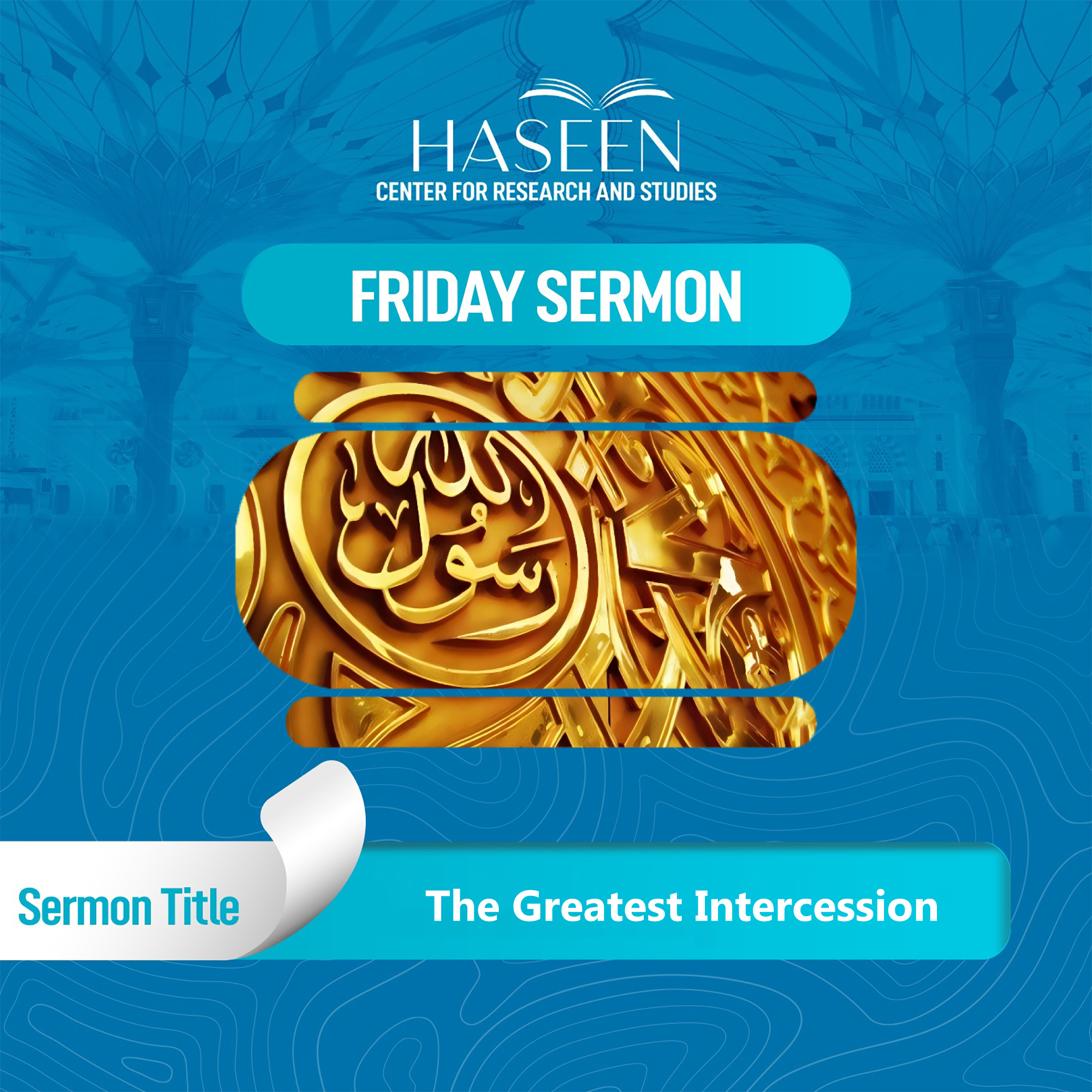
Sermon's Title: The Greatest Intercession
Themes of the Sermon:
1- The Praised Station (al-Maqām al-Maḥmūd).
2- The severity of the terrors of the Day of Resurrection.
3- The magnificant status of the Prophet ﷺ with his Lord.
4- Praising Allah as the key to supplication.
All praise is due to Allah, the Master of the Day of Judgment, who raised the rank of His servant and His Prophet Muḥammad ﷺ above all those who came before and after. I bear witness that there is no deity worthy of worship except Allah alone, with no partner, and I bear witness that Muḥammad is His servant and His Messenger. May Allah send abundant peace and blessings upon him.
To proceed: Fear Allah, O servants of Allah, with true fear of Him, and be mindful of Him in private and in secret. Allah the Exalted says:
يَا أَيُّهَا الَّذِينَ آمَنُوا اتَّقُوا اللَّهَ حَقَّ تُقَاتِهِ وَلَا تَمُوتُنَّ إِلَّا وَأَنْتُمْ مُسْلِمُونَ
“O you who believe, fear Allah as He should be feared, and do not die except in a state of Islam.” [Sūrat Āl ʿImrān: 102]
O servant of Allah, perhaps Allah has blessed you and granted you success to say, after hearing the adhān (the call to prayer), what the Messenger of Allah ﷺ taught us to say. He ﷺ said:
“Whoever says, when he hears the call: Allāhumma rabba hādhihi al-daʿwati al-tāmmah, wa al-ṣalāti al-qāʾimah, āt Muḥammadan al-wasīlah wa al-faḍīlah, wabʿath-hu maqāman maḥmūdan alladhī waʿadtah (O Allah, Lord of this perfect call and the established prayer, grant Muḥammad al-Wasīlah and al-Faḍīlah, and raise him to the Praised Station that You have promised him), my intercession will become permissible for him on the Day of Resurrection.” Narrated by al-Bukhārī.
But I ask you: do you know what the Praised Station (al-Maqām al-Maḥmūd) is, which you ask Allah to grant to His Messenger ﷺ?
It is that Praised Station which Allah promised him when He said:
وَمِنَ اللَّيْلِ فَتَهَجَّدْ بِهِ نَافِلَةً لَكَ عَسَى أَنْ يَبْعَثَكَ رَبُّكَ مَقَامًا مَحْمُودًا
“And during part of the night, stand in prayer with it as an extra act for you; it may be that your Lord will raise you to a Praised Station.” [Sūrat al-Isrāʾ: 79]
Our Prophet ﷺ explained it clearly when he said: “The Praised Station is the intercession.” Narrated by Aḥmad.
It is the station for which all the former and the latter generations will praise him. It is the station of the Greatest Intercession (al-Shafāʿah al-ʿUẓmā). And do you know what the Greatest Intercession is?
Come, let me tell you about it through a truthful narration from the truthful and trustworthy one ﷺ.
The Prophet ﷺ said: “Allah will gather the first and the last of creation at an appointed time on a known Day. They will stand for forty years, their eyes fixed upward toward the sky, waiting for judgment to be passed.” Narrated by al-Ṭabarānī.
It is a Day whose length is as Allah the Exalted described:
تَعْرُجُ الْمَلَائِكَةُ وَالرُّوحُ إِلَيْهِ فِي يَوْمٍ كَانَ مِقْدَارُهُ خَمْسِينَ أَلْفَ سَنَةٍ
“The angels and the Spirit ascend to Him in a Day whose measure is fifty thousand years.” [Sūrat al-Maʿārij: 4]
Allah will gather all creation, the first of them and the last of them. The sun will be brought close to the heads of the servants. They will be barefoot and unclothed. The angels will surround the people, and humanity will be in immense distress, longing for Allah to pass judgment and decide between His creation. So what will they do?
The Messenger of Allah ﷺ answers us, saying:
“I will be the leader of mankind on the Day of Resurrection. Do you know why that is? Allah will gather the first and the last of people on one plain, where the caller’s voice will reach them all and their sight will encompass everything. The sun will draw near, and people will be afflicted with such grief and distress that they will not be able to bear it. Then the people will say: ‘Do you not see what you are suffering? Do you not see what has reached you? Will you not look for someone to intercede for you with your Lord?’ Then some of the people will say to others: ‘Go to Ādam.’
So they will go to Ādam, peace be upon him, and say: ‘O Ādam, you are the father of humanity. Allah created you with His Hand, breathed into you from His spirit, and commanded the angels to prostrate to you. Intercede for us with your Lord. Do you not see what we are in? Do you not see what has reached us?’
Ādam will say: ‘My Lord is angry today with an anger the like of which He has never been angry before, and the like of which He will never be angry again. He forbade me from the tree, and I disobeyed Him. Myself, myself, myself! Go to someone else. Go to Nūḥ.’
They will then go to Nūḥ and say: ‘O Nūḥ, you are the first of the messengers sent to the people of the earth, and Allah named you a grateful servant. Intercede for us with your Lord. Do you not see what we are in?’
He will say: ‘My Lord is angry today with an anger the like of which He has never been angry before, and the like of which He will never be angry again. I once made a supplication against my people. Myself, myself, myself! Go to someone else. Go to Ibrāhīm.’
They will go to Ibrāhīm and say: ‘O Ibrāhīm, you are the Prophet of Allah and His close servant (khalīl) among the people of the earth. Intercede for us with your Lord. Do you not see what we are in?’
He will say: ‘My Lord is angry today with an anger the like of which He has never been angry before, and the like of which He will never be angry again. I told three untruths. Myself, myself, myself! Go to someone else. Go to Mūsā.’
They will go to Mūsā and say: ‘O Mūsā, you are the Messenger of Allah. Allah favored you with His message and His speech over the people. Intercede for us with your Lord. Do you not see what we are in?’
He will say: ‘My Lord is angry today with an anger the like of which He has never been angry before, and the like of which He will never be angry again. I killed a soul that I was not commanded to kill. Myself, myself, myself! Go to someone else. Go to ʿĪsā ibn Maryam.’
They will go to ʿĪsā and say: ‘O ʿĪsā, you are the Messenger of Allah, His Word which He cast to Maryam, and a spirit from Him. You spoke to people in the cradle as a child. Intercede for us with your Lord. Do you not see what we are in?’
ʿĪsā will say: ‘My Lord is angry today with an anger the like of which He has never been angry before, and the like of which He will never be angry again.’ And he will not mention any sin. ‘Myself, myself, myself! Go to someone else. Go to Muḥammad.’
Then they will come to Muḥammad ﷺ and say: ‘O Muḥammad, you are the Messenger of Allah and the Seal of the Prophets. Allah has forgiven for you what came before of your sins and what came after. Intercede for us with your Lord. Do you not see what we are in?’
So, I will go and come beneath the Throne, and I will fall down in prostration before my Lord, Mighty and Majestic. Then Allah will inspire me with praises and words of glorification such as He has never inspired anyone before me. Then it will be said: ‘O Muḥammad, raise your head. Ask, and you will be given. Intercede, and your intercession will be accepted.’” Narrated by al-Bukhārī and Muslim.
How intense and terrifying are the horrors of the Day of Resurrection! On that Day, Allah—the Most Forbearing, the Most Patient—will become angry with an anger the like of which He has never shown before, and the like of which He will never show again. So much so that the prophets, and even the messengers of firm resolve (ūlū al-ʿazm), will say: ‘Myself, myself!’ So, what, then, will be our state, O servants of Allah?
It is most fitting for every God-fearing believer that their condition be as Allah the Exalted described:
الَّذِينَ يَخْشَوْنَ رَبَّهُمْ بِالْغَيْبِ وَهُمْ مِنَ السَّاعَةِ مُشْفِقُونَ
“Those who fear their Lord while unseen, and who are apprehensive of the Hour.” [Sūrat al-Anbiyāʾ: 49]
Then consider: what a noble and exalted rank our Prophet ﷺ attained with his Lord, such that the messengers of firm resolve step back, and he steps forward ahead of them before the Lord of all worlds in that tremendous scene.
It is he ﷺ who said: “I am the leader of the children of Ādam on the Day of Resurrection, the first whose grave will be split open, the first to intercede, and the first whose intercession will be accepted.” Narrated by Muslim.
And he ﷺ also said: “I am the leader of the children of Ādam on the Day of Resurrection—without boasting. In my hand will be the Banner of Praise—without boasting. There will be no prophet on that Day, from Ādam or anyone else, except that they will be under my banner. And I will be the first for whom the earth will split open—without boasting.” Narrated by al-Tirmidhī.
If Ādam, peace be upon him, excused himself from the station of intercession because he ate from the tree—despite having repented and having his repentance accepted;
and if Nūḥ, peace be upon him, the first messenger among those of firm resolve, the grateful servant who called his people to Allah for nine hundred and fifty years, excused himself because he once supplicated to Allah to drown the earth and destroy the disbelievers—though they were deserving of that; and if Ibrāhīm, the close servant of the Most Merciful, the upright leader of a nation, the devoted monotheist whom Allah chose and selected, excused himself from that station because he used indirect speech (maʿārīḍ) in three situations mentioned by the Prophet ﷺ, who said:
“Ibrāhīm, the Prophet—peace be upon him—never told a lie except three times: two for the sake of Allah—his saying, ‘I am sick,’ and his saying, ‘Rather, this big one of them did it’—and one concerning Sārah.” Narrated by Muslim.
It is well known that the statement concerning his wife Sārah was when he told the oppressive tyrant that she was his sister—meaning, his sister in Islam—in order to ward off his aggression from them both, which was necessary. Yet despite this, Ibrāhīm excused himself from the station of intercession because of these three instances, due to his profound knowledge of his Lord and his deep awareness of the immense status of the Greatest Intercession.
And if Mūsā, peace be upon him—the one whom the Most Merciful spoke to directly, and to whom Allah revealed the Torah—excused himself from the Greatest Intercession because he killed a soul by mistake, though he sought forgiveness from his Lord and was forgiven; and if ʿĪsā, peace be upon him—who is the servant of Allah, His spirit, and His word, whom Allah made honored in this world and the Hereafter—did not find anyone worthy of that station except our Prophet ﷺ, for whom Allah forgave what came before of his sins and what came after; then at that moment, you realize that our Prophet Muḥammad ﷺ is the leader of the children of Ādam, the greatest of creation in status and rank before Allah, the highest of them in position and honor.
Therefore, it is our duty to believe in him, to love him, to honor and revere him, to obey him, to follow his Sunnah (his way and teachings), and to send prayers and blessings upon him ﷺ.
O servants of Allah:
It is the Prophet ﷺ himself who taught us to ask Allah the Exalted to raise him to the Praised Station. And for this reason, he ﷺ will not intercede until he prostrates before his Lord, praises Him, and seeks His permission—then Allah will grant him permission.
For all intercession belongs entirely to Allah. No one can intercede except by His permission. Allah the Exalted says:
لَهُ مَا فِي السَّمَاوَاتِ وَمَا فِي الْأَرْضِ مَنْ ذَا الَّذِي يَشْفَعُ عِنْدَهُ إِلَّا بِإِذْنِهِ
“To Him belongs whatever is in the heavens and whatever is on the earth. Who is it that can intercede with Him except by His permission?” [Sūrat al-Baqarah: 255]
All authority belongs to Allah alone. All intercession belongs to Him alone. Glorified is He, and praised.
May Allah bless me and you through the Mighty Qurʾān, and benefit me and you through its verses and its wise reminder. I seek forgiveness from Allah for myself and for you, so seek His forgiveness. Indeed, He is the Most Forgiving, the Most Merciful.
The Second Sermon:
All praise is due to Allah, and may peace and blessings be upon the Messenger of Allah, upon his family, his Companions, and all who follow his way. To proceed:
Indeed, the Prophet ﷺ places before his intercession his prostration to his Lord and his praise of Him with the greatest forms of praise—praises by which he opens the gates of the mercy of the Most Merciful, the Most Compassionate, praises that Allah had never granted to anyone before him.
He begins his praise of his Lord as he ﷺ informed us, saying:
“I am at Your service and ready to obey You; all goodness is in Your hands, and evil is not attributed to You. The rightly guided is the one You have guided. Your servant stands before You; from You I come, and to You I return. There is no refuge and no escape from You except with You. You are Blessed and Exalted. Glory be to You, O Lord of the Sacred House.” Narrated by al-Nasāʾī.
And this is not all. Rather, as he ﷺ said: “And He inspires me with praises by which I praise Him—praises that are not present with me now.” Narrated by al-Bukhārī and Muslim.
Do you know how long the Prophet ﷺ remains in prostration before the Throne, praising his Lord?
He ﷺ informed us that: “He falls into prostration for the length of a week, and Allah, Mighty and Majestic, says: ‘Raise your head, O Muḥammad, and speak—you will be heard; intercede, and your intercession will be accepted.’ He then raises his head, and when he looks at his Lord, Mighty and Majestic, he falls again into prostration for the length of another week. Then Allah, Mighty and Majestic, says: ‘Raise your head, and speak—you will be heard; intercede, and your intercession will be accepted.’” Narrated by Aḥmad.
Indeed, praising Allah means extolling Him with attributes of perfection and descriptions of majesty, combined with love and reverence—and through such praise Allah responds to the supplication of His servant.
O Allah, grant victory to Islam and honor the Muslims, and destroy the Zionist criminals. O Allah, send down tranquility into the hearts of those striving in Your path, rescue Your oppressed servants, and raise high the banner of the religion—by Your power, O All-Powerful, O Ever-Strong.
O Allah, forgive the Muslim men and Muslim women, the believing men and believing women, the living among them and the dead. O Allah, grant success to our leader in authority in that which You love and are pleased with, and guide him firmly to righteousness and God-consciousness. Our Lord, grant us good in this world and good in the Hereafter, and protect us from the punishment of the Fire.
O servants of Allah, remember Allah with much remembrance, and glorify Him morning and evening. And our final supplication is that all praise belongs to Allah, Lord of all worlds.