
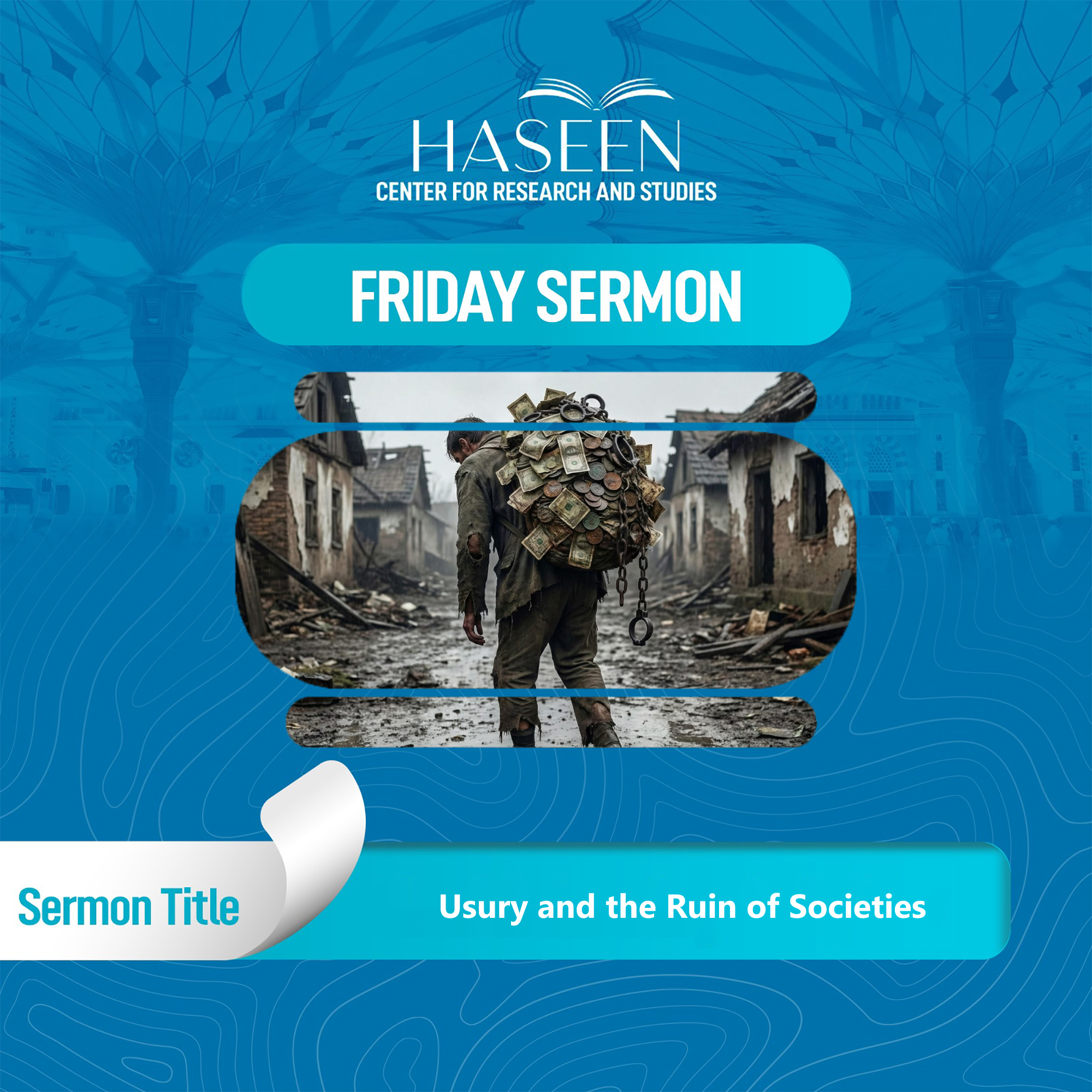
Sermon's Title: Usury and the Ruin of Societies
Themes of the Sermon:
1- Allah’s war against those who consume usury.
2- The abhorrence of usury in Islam.
3- The danger of loan-based usury.
4- Usury has many other pathways.
All praise is due to Allah, who permitted wholesome things and made them a source of sufficiency and blessings, and who forbade impure things and threatened their practitioners with humiliation and the removal of all blessings. I bear witness that there is no deity worthy of worship except Allah alone without partner, and I bear witness that Muḥammad is His servant and Messenger. May Allah’s peace and abundant blessings be upon him.
To proceed: Fear Allah, servants of Allah, with true God-consciousness, and be mindful of Him in secret and in public:
يَا أَيُّهَا الَّذِينَ آمَنُوا اتَّقُوا اللَّهَ حَقَّ تُقَاتِهِ وَلَا تَمُوتُنَّ إِلَّا وَأَنْتُمْ مُسْلِمُونَ
.“O you who believe, fear Allah as He should be feared and do not die except as Muslims.” [Āl ʿImrān: 102]
Servants of Allah:
Have you ever seen a man—or a nation—against whom the entire world gathers in war, with their power, their preparations, their plots, and their force? Do you think such people would ever prosper?
Then what if it is a servant upon whom Allah Himself has declared war? Who could protect him from the Might of Allah?
You may ask: Who is this forsaken person who deserves the war of the Almighty, the Compeller? He is the consumer of usury. Our Lord warned us in His Book, saying to the believers:
يَا أَيُّهَا الَّذِينَ آمَنُوا اتَّقُوا اللَّهَ وَذَرُوا مَا بَقِيَ مِنَ الرِّبَا إِنْ كُنْتُمْ مُؤْمِنِينَ * فَإِنْ لَمْ تَفْعَلُوا فَأْذَنُوا بِحَرْبٍ مِنَ اللَّهِ وَرَسُولِهِ وَإِنْ تُبْتُمْ فَلَكُمْ رُءُوسُ أَمْوَالِكُمْ لَا تَظْلِمُونَ وَلَا تُظْلَمُونَ
“O you who believe, fear Allah and give up what remains of usury, if you are truly believers. But if you do not, then be informed of a war from Allah and His Messenger. But if you repent, you may have your principal; you do no wrong nor are you wronged.” [Sūrat al-Baqarah: 278–279]
You will not find any sin—after shirk—that carries a punishment as terrifying as this: a direct declaration of war from Allah.
Imām Mālik ibn Anas said: “I examined the Book of Allah and the Sunnah of His Prophet ﷺ, and I did not see anything more evil than usury, for Allah has declared war against it.”
A war from Allah and His Messenger ﷺ against those who consume usury—in this world and in the Hereafter.
As for this world: Allah wipes out their blessings, destroys their prosperity, removes the goodness they enjoy, and makes their lives tight, impoverished, and ruined. Allah says:
يَمْحَقُ اللَّهُ الرِّبَا وَيُرْبِي الصَّدَقَاتِ وَاللَّهُ لَا يُحِبُّ كُلَّ كَفَّارٍ أَثِيمٍ
“Allah destroys usury and increases charity. And Allah does not love every ungrateful sinner.” [Sūrat al-Baqarah: 276]
The Prophet ﷺ said: “No one increases in usury except that the outcome of his affairs becomes diminished.” Reported by Ibn Mājah.
And when the Children of Israel indulged in usury, Allah deprived them of wholesome provisions:
فَبِظُلْمٍ مِنَ الَّذِينَ هَادُوا حَرَّمْنَا عَلَيْهِمْ طَيِّبَاتٍ أُحِلَّتْ لَهُمْ وَبِصَدِّهِمْ عَنْ سَبِيلِ اللَّهِ كَثِيرًا * وَأَخْذِهِمُ الرِّبَا وَقَدْ نُهُوا عَنْهُ
“Because of wrongdoing by those who were Jewish, We forbade them good things which had been lawful to them… and for their taking usury though they had been forbidden from it.” [Sūrat al-Nisā’: 160–161]
If the usury-consumer dies, Allah punishes him in the life of al-Barzakh with a humiliating torment. Have you ever heard of a river of blood?
Come, and listen to something astonishing.
The Prophet ﷺ said: “Two men came to me and took me to a sacred land. We proceeded until we came upon a river of blood. In it was a man standing, and on the bank was another man with stones in front of him. Whenever the man in the river tried to come out, the man on the bank threw a stone into his mouth and forced him back to where he was. This continued each time he tried to get out.
I asked, ‘What is this?’
They said: ‘The one you saw in the river is the consumer of usury.’” Reported by al-Bukhārī and Muslim.
But the story does not end in the grave. On the Day of Resurrection he will face a far more humiliating and severe punishment. Do you know how the consumer of usury will be resurrected? Allah says:
الَّذِينَ يَأْكُلُونَ الرِّبَا لَا يَقُومُونَ إِلَّا كَمَا يَقُومُ الَّذِي يَتَخَبَّطُهُ الشَّيْطَانُ مِنَ الْمَسِّ ذَلِكَ بِأَنَّهُمْ قَالُوا إِنَّمَا الْبَيْعُ مِثْلُ الرِّبَا وَأَحَلَّ اللَّهُ الْبَيْعَ وَحَرَّمَ الرِّبَا فَمَنْ جَاءَهُ مَوْعِظَةٌ مِنْ رَبِّهِ فَانْتَهَى فَلَهُ مَا سَلَفَ وَأَمْرُهُ إِلَى اللَّهِ وَمَنْ عَادَ فَأُولَئِكَ أَصْحَابُ النَّارِ هُمْ فِيهَا خَالِدُونَ
“Those who consume usury will not stand except as one stands who is being beaten by Satan into insanity… That is because they say, ‘Trade is just like usury,’ while Allah has permitted trade and forbidden usury. So whoever receives admonition from his Lord and stops may keep what has passed, and his affair is with Allah. But whoever returns—those are the people of the Fire; they will abide therein forever.” [Sūrat al-Baqarah: 275]
People will rise quickly on that Day, but the usury-consumer—who filled his stomach with impurity—will rise like a madman seized and strangled by Satan, unable to stand.
Then Allah will fulfill against him the very threat He announced as a declaration of war. Ibn ʿAbbās said: “It will be said on the Day of Resurrection to the consumer of usury: ‘Take up your weapons for war!’”
Servants of Allah:
Usury is forbidden by Allah in every revealed law; it has never been made lawful in any sacred system. That is due to the magnitude of its corruption and the severity of its evil.
The Prophet ﷺ counted it among the destructive, ruinous sins, saying: “Avoid the seven destructive sins.” He then mentioned among them: “Consuming usury.” Reported by al-Bukhārī and Muslim.
The Prophet ﷺ intensified the warning against usury to the point that he cursed everyone who participates in it—even by merely writing its contract or bearing witness to it.
Jabir ibn Abd Allah, may Allah be pleased with him, said: “The Messenger of Allah ﷺ cursed the one who consumes usury, the one who pays it, the one who writes it, and its two witnesses,” and he said: “They are all alike.” Reported by Muslim.
And because of the extreme repulsiveness of usury in the sight of Allah, the Prophet ﷺ declared it even more severe than fornication.
The Messenger of Allah ﷺ said: “One dirham of usury which a man consumes knowingly is worse than committing fornication thirty-six times.” Reported by Ahmad.
Do you see how one single dirham of usury is, in Allah’s sight, a greater sin than thirty-six acts of fornication? You may now ask: What is the usury that the Shari’ah intended to prohibit?
In language, the word riba means increase. In the Shari’ah, it refers to several forms of financial transactions. The most well-known—and the one practiced in Jāhiliyyah—is what is called riba al-qard (loan-based usury). A person would borrow money, and when the time of repayment came, the lender would say: “Will you pay now, or shall we increase the debt upon you?”
Islam came and forbade this entirely. The Prophet ﷺ abolished it and nullified its practice. He said in his sermon at ʿArafah: “Riba of the Jāhiliyyah is abolished. The first usury I abolish is our own usury—the usury of Abbas ibn Abd al-Muttalib; all of it is abolished.” Reported by Muslim.
This type of usury is the most evil and the most widespread. In the past, it was practiced by individual moneylenders, despised and cursed by society. But today, under the savagery of capitalism and the allure of unrestricted financial liberty, it is practiced by banking institutions and financing companies. They call people to deposit their wealth, promising them interest-based returns. Individuals and corporations flock to these institutions to take usurious loans, which they falsely renamed “interest” to make them marketable to the people.
They even tailor deviant religious verdicts to attract those weak in faith—until homes were ruined, societies corrupted, poverty spread, prisons filled, families displaced, and nations collapsed under the claws of a sinful West.
Scholars and fiqh councils across the Muslim world issue fatwas declaring the so-called “bank interest” forbidden, unanimously affirming that it is usury. Every loan that brings a guaranteed additional benefit is forbidden usury—whether the loan is for production or consumption.
In our religion—the religion of justice and mercy—Allah has legislated lawful trade, permitted sale, and prescribed mudārabah and all forms of partnership, where neither the investor nor the working partner is wronged. He legislated loans among people as an act of kindness and mutual mercy, without any condition of benefit or increase, and He promised great reward for it.
The Prophet ﷺ said: “A man entered Paradise and saw written upon its gate: ‘Charity is rewarded tenfold, and a loan is rewarded eighteenfold.’” Reported by al-Tabarani.
Allah also legislated contracts of security and documentation so that creditors may ensure their rights. He commanded the writing of contracts and prescribed collateral and guarantees. And if the debtor is in hardship, Allah commanded the creditor to grant him time until ease, saying:
وَإِنْ كَانَ ذُو عُسْرَةٍ فَنَظِرَةٌ إِلَى مَيْسَرَةٍ وَأَنْ تَصَدَّقُوا خَيْرٌ لَكُمْ إِنْ كُنْتُمْ تَعْلَمُونَ
“And if the debtor is in hardship, then grant him time until ease. But if you remit it as charity, it is better for you—if you only knew.” [Sūrat al-Baqarah: 280]
And the reward for this is shade on the Day of Resurrection. The Prophet ﷺ said: “Whoever gives respite to one in difficulty—or forgives him—Allah will shade him in His shade.” Reported by Muslim.
May Allah bless me and you through the Noble Qur’an, and benefit us with its verses and wise reminder. I seek Allah’s forgiveness for myself and for you; so seek His forgiveness—for He is the Most Forgiving, the Most Merciful.
The Second Sermon:
All praise is due to Allah, and may peace and blessings be upon the Messenger of Allah, his family, his companions, and all who follow him. To proceed:
Usury does not stop at riba al-qard (loan-based usury). There are other types of usury mentioned explicitly by the Prophet ﷺ in well-known categories, referred to as riba al-faḍl and riba al-nasīʾah.
The Messenger of Allah ﷺ said: “Gold for gold, silver for silver, wheat for wheat, barley for barley, dates for dates, and salt for salt—like for like, hand to hand. Whoever increases or seeks an increase has engaged in usury. The taker and the giver are the same in this regard.” Reported by Muslim.
It is therefore obligatory for every Muslim to ask the people of knowledge, before buying and selling, about transactions that involve usury—otherwise he may consume usury knowingly or unknowingly.
ʿUmar ibn al-Khaṭṭāb, may Allah be pleased with him, said: “No one should sell in our marketplace except someone who has understanding of the religion.” Reported by al-Tirmidhi.
And know, servants of Allah, that a person will not save himself from Allah’s anger by saying, “I did not intend to consume usury,” while proceeding to engage in whatever he wishes.
Al-Qurṭubī said: “If usury were forbidden only for those who intended it, then it would be prohibited only for the jurists!”
If we truly want honor, dignity, and blessings from the Lord of the worlds, then it is upon us—individuals, institutions, societies, and states—to fear Allah and refrain from every form of usurious transaction. Allah has promised:
وَلَوْ أَنَّ أَهْلَ الْقُرَى آمَنُوا وَاتَّقَوْا لَفَتَحْنَا عَلَيْهِمْ بَرَكَاتٍ مِنَ السَّمَاءِ وَالْأَرْضِ
“If the people of the towns had believed and feared Allah, We would have opened for them blessings from the heavens and the earth.” [Sūrat al-Aʿrāf: 96]
And He warned those who turn away. The Prophet ﷺ said: “Usury and fornication never appear among a people except that they bring Allah’s punishment upon themselves.” Reported by Ahmad.
In conclusion: Whoever has fallen into usury and wishes to repent to Allah, then he may take back his principal, as Allah says:
وَإِنْ تُبْتُمْ فَلَكُمْ رُءُوسُ أَمْوَالِكُمْ لَا تَظْلِمُونَ وَلَا تُظْلَمُونَ
“If you repent, then you may have your principal—you do no wrong, nor are you wronged.” [Sūrat al-Baqarah: 279]
As for usurious money he took unjustly, it is obligatory upon him to return it to its rightful owners. If he does not know them, or if he searches for them and cannot find them, then he must give it in charity on their behalf, as a purification of his wealth from unlawful impurity. And Allah is Forgiving, Merciful.
O Allah, support Islam and grant honor to the Muslims, and destroy the criminals.
O Allah, send tranquility into the hearts of those striving in Your path, deliver Your oppressed servants, and raise high the banner of the religion by Your might, O Mighty, O Firm.
O Allah, forgive the Muslim men and women, the believing men and women, the living among them and the dead.
O Allah, grant success to our leader in what You love and are pleased with, and take him by the forelock to righteousness and piety.
Our Lord, give us good in this world and good in the Hereafter, and protect us from the punishment of the Fire.
Servants of Allah: remember Allah with abundant remembrance, and glorify Him morning and evening.
Our final supplication is that all praise is due to Allah, Lord of the worlds.