
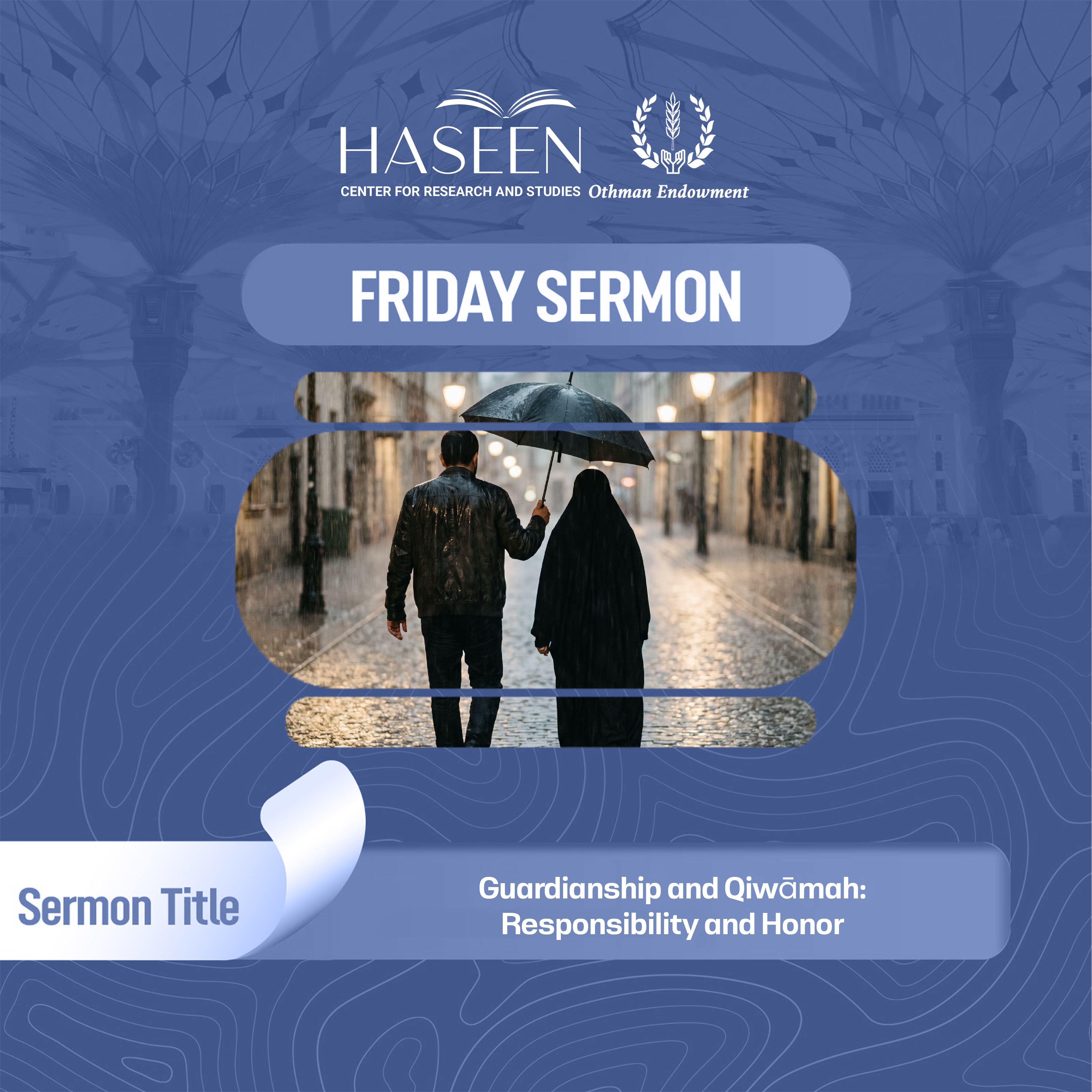
Title of the Sermon: Guardianship and Qiwāmah: Responsibility and Honor
Themes of the Sermon:
1- The bond of faith between believing men and women
2- Guardianship over women and its guidelines
3- Qiwāmah is both an honor and a responsibility
4-The relationship between husband and wife: rights and excellence in conduct
All praise is due to Allah, who sent down the Book and placed no crookedness in it, and whose words are perfected in truth and justice. I bear witness that there is no deity worthy of worship except Allah, and I bear witness that Muḥammad is the servant of Allah and His Messenger. May Allah send abundant peace and blessings upon him.
To proceed:
Fear Allah, servants of Allah, as He truly deserves to be feared, and remain mindful of Him in private and in secret. Allah says:
يَا أَيُّهَا الَّذِينَ آمَنُوا اتَّقُوا اللَّهَ حَقَّ تُقَاتِهِ وَلَا تَمُوتُنَّ إِلَّا وَأَنْتُمْ مُسْلِمُونَ
“O you who believe, fear Allah as He should truly be feared, and do not die except as Muslims.” [Sūrat Āl ʿImrān: 102]
Servants of Allah:
While the Companions were teaching the Tābiʿūn the teachings of this magnificent religion, a question arose between the men and women. Do you know what it was?
Muḥammad ibn Sīrīn, may Allah have mercy upon him, said: “They were either boasting to one another or discussing whether there would be more men or women in Paradise.”
Abū Hurayrah, may Allah be pleased with him, said: “Did Abū al-Qāsim ﷺ not say: “The first group to enter Paradise will have faces like the full moon on the night it is complete. The group after them will be like the brightest shining star in the sky. Every man among them will have two wives. The marrow of their shins will be visible through the flesh, and there will be no unmarried person in Paradise” Narrated by Muslim.
What an extraordinary generation they were! These were the matters that occupied their minds: which of them was closer to his Lord and more obedient to Him, and which of them would have the greater share of the Gardens of eternal bliss.
Servants of Allah:
Allah, Exalted, says:
وَالْمُؤْمِنُونَ وَالْمُؤْمِنَاتُ بَعْضُهُمْ أَوْلِيَاءُ بَعْضٍ يَأْمُرُونَ بِالْمَعْرُوفِ وَيَنْهَوْنَ عَنِ الْمُنْكَرِ وَيُقِيمُونَ الصَّلَاةَ وَيُؤْتُونَ الزَّكَاةَ وَيُطِيعُونَ اللَّهَ وَرَسُولَهُ أُولَئِكَ سَيَرْحَمُهُمُ اللَّهُ إِنَّ اللَّهَ عَزِيزٌ حَكِيمٌ
“The believing men and believing women are allies of one another. They command what is right, forbid what is wrong, establish prayer, give zakāh, and obey Allah and His Messenger. It is they upon whom Allah will have mercy. Indeed, Allah is Almighty, All-Wise.” [Sūrat al-Tawbah: 71]
The relationship between men and women in Islam is founded upon brotherhood and sisterhood in faith, complementing and supporting one another.
Islam does not establish a battle or conflict between men and women. The religion of Allah is for both men and women. Allah, Glorified, says:
وَمَنْ يَعْمَلْ مِنَ الصَّالِحَاتِ مِنْ ذَكَرٍ أَوْ أُنْثَى وَهُوَ مُؤْمِنٌ فَأُولَئِكَ يَدْخُلُونَ الْجَنَّةَ وَلَا يُظْلَمُونَ نَقِيرًا
“Whoever does righteous deeds, whether male or female, while being a believer, they will enter Paradise and will not be wronged even as much as the speck on a date stone.” [Sūrat al-Nisāʾ: 124]
And the Prophet ﷺ said: “Women are the counterparts of men.” Narrated by al-Tirmidhī.
Yet the people of deviation and misguidance have continually tried to turn women against men, claiming that women are oppressed and subjugated. Out of ignorance or heresy, they claim that religion is responsible for this because it gave men guardianship and qiwāmah over women.
But is the matter really as these deceivers claim? Islam is the religion of wisdom, mercy, and justice. It was legislated by our Lord, who says:
أَلَا يَعْلَمُ مَنْ خَلَقَ وَهُوَ اللَّطِيفُ الْخَبِيرُ
“Does the One who created not know, while He is the Most Subtle, the All-Aware?” [Sūrat al-Mulk: 14]
There is no ruling within Islam except that it contains wisdom and benefit and carries goodness for this world and the Hereafter. Allah, Glorified, says:
وَلَيْسَ الذَّكَرُ كَالْأُنْثَى
“And the male is not like the female.” [Sūrat Āl ʿImrān: 36]
People of sound reason have agreed that men differ from women physically, psychologically, and intellectually.
The Prophet ﷺ also informed us that women have a deficiency in reason and religion in comparison to men. He said: “I have not seen anyone deficient in reason and religion who can more effectively overcome the mind of a determined man than one of you.”
They asked, “O Messenger of Allah, what is the deficiency in our religion and our reason?”
He said: “Is not the testimony of a woman equal to half the testimony of a man?”
They replied, “Yes.”
He said: “That is part of the deficiency in her reason. And is it not the case that when she menstruates, she neither prays nor fasts?”
They replied, “Yes.”
He said: “That is part of the deficiency in her religion.” Narrated by al-Bukhārī and Muslim.
For this reason, Allah distinguished men with rulings appropriate to their masculinity and women with rulings appropriate to their femininity.
Because emotion generally has a stronger influence upon women, and because they do not manage certain affairs in the same way as men, the Sharīʿah prevented women from holding positions of general authority.
The Prophet ﷺ said: “A people who entrust their affairs to a woman will never prosper.” Narrated by al-Bukhārī.
Accordingly, a woman does not assume political rule or judgeship. Allah also gave men guardianship over women in certain matters, but not in every matter.
Among these is guardianship in marriage. The Prophet ﷺ said: “Any woman who marries without the permission of her guardian, her marriage is invalid.” He repeated this three times.” Narrated by al-Tirmidhī.
Islam also prohibited a woman from travelling except with a maḥram, as a means of protecting her. The Prophet ﷺ said: “A woman must not travel except with a maḥram.” Narrated by al-Bukhārī and Muslim.
Guardianship does not mean tyranny or harshness. Rather, it is a mercy from Allah. The very meaning of wilāyah is connected to closeness. A walī, or guardian, is called such because of his closeness to the person under his guardianship, as he looks after that person with protection and care.
The woman’s guardian is therefore a close relative who takes responsibility for her affairs and looks after her interests through care, support, and sound management.
Men know other men better, are more familiar with the realities of life, are generally better able to ask questions and investigate, and are more able to give precedence to rational judgment over emotions and feelings.
Guardianship does not mean oppression or coercion, nor does it permit transgression or the violation of rights.
If a father wishes to marry his daughter to someone, he must seek her permission. If she refuses, he may not force her. If he marries her without her consent, she may take the matter to the judge, who gives her the choice either to accept or reject the marriage.
A woman whose father had married her while she had previously been married disliked the marriage. She came to the Messenger of Allah ﷺ, and “he annulled her marriage.” Narrated by al-Bukhārī.
ʿĀʾishah also asked the Messenger of Allah ﷺ concerning a young woman whose family wished to marry her: “Should her permission be sought or not?”
The Messenger of Allah ﷺ replied: “Yes, her permission must be sought.”
ʿĀʾishah said, “But she may be shy.” The Messenger of Allah ﷺ said: “Her silence is her permission.” Narrated by Muslim.
If suitable men seek a woman’s hand in marriage and her guardian unjustly prevents her from marrying, he is sinful. Allah says:
وَإِذَا طَلَّقْتُمُ النِّسَاءَ فَبَلَغْنَ أَجَلَهُنَّ فَلَا تَعْضُلُوهُنَّ أَنْ يَنْكِحْنَ أَزْوَاجَهُنَّ إِذَا تَرَاضَوْا بَيْنَهُمْ بِالْمَعْرُوفِ ذَلِكَ يُوعَظُ بِهِ مَنْ كَانَ مِنْكُمْ يُؤْمِنُ بِاللَّهِ وَالْيَوْمِ الْآخِرِ ذَلِكُمْ أَزْكَى لَكُمْ وَأَطْهَرُ وَاللَّهُ يَعْلَمُ وَأَنْتُمْ لَا تَعْلَمُونَ
“When you divorce women and they have reached the end of their waiting period, do not prevent them from marrying their husbands when they mutually agree upon what is reasonable. This is an admonition for whoever among you believes in Allah and the Last Day. That is purer and cleaner for you. Allah knows, while you do not know.” [Sūrat al-Baqarah: 232]
An adult woman of sound judgment also has complete freedom to dispose of her own wealth. No one else is permitted to take control of it or dispose of it on her behalf without right.
The bridal gift that Allah has made her right may not be taken from her by men unless she willingly gives something of it. Allah says:
وَآتُوا النِّسَاءَ صَدُقَاتِهِنَّ نِحْلَةً فَإِنْ طِبْنَ لَكُمْ عَنْ شَيْءٍ مِنْهُ نَفْسًا فَكُلُوهُ هَنِيئًا مَرِيئًا
“Give women their bridal gifts graciously. But if they willingly give up to you something of it, then take it with pleasure and satisfaction.” [Sūrat al-Nisāʾ: 4]
And He says:
وَإِنْ أَرَدْتُمُ اسْتِبْدَالَ زَوْجٍ مَكَانَ زَوْجٍ وَآتَيْتُمْ إِحْدَاهُنَّ قِنْطَارًا فَلَا تَأْخُذُوا مِنْهُ شَيْئًا أَتَأْخُذُونَهُ بُهْتَانًا وَإِثْمًا مُبِينًا
“If you wish to replace one wife with another and you have given one of them a great amount of wealth, do not take anything back from it. Would you take it through false accusation and manifest sin?” [Sūrat al-Nisāʾ: 20]
Servants of Allah:
Allah has granted men qiwāmah over women. He says:
الرِّجَالُ قَوَّامُونَ عَلَى النِّسَاءِ بِمَا فَضَّلَ اللَّهُ بَعْضَهُمْ عَلَى بَعْضٍ وَبِمَا أَنْفَقُوا مِنْ أَمْوَالِهِمْ فَالصَّالِحَاتُ قَانِتَاتٌ حَافِظَاتٌ لِلْغَيْبِ بِمَا حَفِظَ اللَّهُ وَاللَّاتِي تَخَافُونَ نُشُوزَهُنَّ فَعِظُوهُنَّ وَاهْجُرُوهُنَّ فِي الْمَضَاجِعِ وَاضْرِبُوهُنَّ فَإِنْ أَطَعْنَكُمْ فَلَا تَبْغُوا عَلَيْهِنَّ سَبِيلًا إِنَّ اللَّهَ كَانَ عَلِيًّا كَبِيرًا
“Men are caretakers and maintainers of women because Allah has given some of them an advantage over others and because they spend from their wealth. Therefore, righteous women are devoutly obedient and guard in their husbands’ absence what Allah would have them guard. As for those from whom you fear defiance, admonish them, then leave them alone in their beds, then strike them. But if they obey you, do not seek any way against them. Indeed, Allah is Most High, Most Great.” [Sūrat al-Nisāʾ: 34]
Qiwāmah entails leadership and authority, and it is both an honor and a responsibility. Allah has favored men as a sex over women in certain respects. He says:
وَلَهُنَّ مِثْلُ الَّذِي عَلَيْهِنَّ بِالْمَعْرُوفِ وَلِلرِّجَالِ عَلَيْهِنَّ دَرَجَةٌ
“Women have rights similar to the obligations upon them, according to what is reasonable, but men have a degree over them.” [Sūrat al-Baqarah: 228]
For this reason, Allah specifically assigned prophethood, public authority, judgeship, divorce, taking a divorced wife back during her waiting period, jihād, and other such matters to men.
From this perspective, the Sharīʿah made the man responsible for the woman, meaning that he is responsible for her maintenance, care, management, and discipline.
This is due to what men have specifically been given of sound judgment, ability to manage affairs, consideration of interests, and handling of different situations, as well as what Allah has obligated upon them of the bridal gift, financial maintenance, and care of the household.
This honor therefore carries responsibility and duty within it. A woman is like a protected sanctuary that men are required to defend. This is an obligation upon them without disagreement.
For this reason, the Prophet ﷺ said: “Whoever is killed defending his family is a martyr.” Narrated by al-Tirmidhī.
Furthermore, a man’s financial maintenance of his family and providing for their needs so that they do not have to work is an obligation upon him, not merely an act of generosity.
The Prophet ﷺ said: “It is sufficient sin for a man that he withholds sustenance from those whose provision he is responsible for.” Narrated by Muslim.
The Prophet ﷺ also said: “Every one of you is a shepherd, and every one of you is responsible for his flock. The ruler is a shepherd and is responsible for his flock. A man is a shepherd over his family and is responsible for his flock. A woman is a shepherd over the home of her husband and his children, and she is responsible for them.” Narrated by al-Bukhārī and Muslim.
This qiwāmah likewise does not permit oppression of women. Allah describes the righteous woman as being obedient to her husband. He says:
فَالصَّالِحَاتُ قَانِتَاتٌ حَافِظَاتٌ لِلْغَيْبِ بِمَا حَفِظَ اللَّهُ
“Therefore, righteous women are devoutly obedient and guard in their husbands’ absence what Allah would have them guard.” [Sūrat al-Nisāʾ: 34]
The meaning of qānitāt here is that they are obedient to Allah and to their husbands. The reward for this is immense. The Prophet ﷺ said: “If a woman performs her five prayers, fasts her month, guards her chastity, and obeys her husband, it will be said to her: “Enter Paradise through whichever of its gates you wish.”
Narrated by Aḥmad.
At the same time, this obedience is not absolute. Rather, it applies to matters concerning married life and to what Allah has made lawful.
The Prophet ﷺ said: “Obedience is only in what is right.” Narrated by al-Bukhārī and Muslim.
Although a wife does not leave her husband’s home without his permission, as this is among his rights and part of his qiwāmah over her, the Prophet ﷺ nevertheless said: “If the wife of one of you seeks permission to go to the mosque, do not prevent her.” Narrated by al-Bukhārī and Muslim.
This ḥadīth indicates that a wife should seek her husband’s permission to go to the mosque, and seeking his permission to go elsewhere is even more appropriate.
At the same time, the ḥadīth also prohibits the husband from refusing her request, so long as he does not fear temptation or harm.
May Allah bless me and you through the Magnificent Qurʾān and benefit me and you through its verses and wise reminder.
I seek Allah’s forgiveness for myself and for you, so seek His forgiveness. Indeed, He is the All-Forgiving, the Most Merciful.
The Second Sermon
All praise is due to Allah. May peace and blessings be upon the Messenger of Allah, his family, his Companions, and all those who follow him.
To proceed:
Married life and the relationship between a husband and his wife are founded upon love and mercy. Our Lord says:
وَمِنْ آيَاتِهِ أَنْ خَلَقَ لَكُمْ مِنْ أَنْفُسِكُمْ أَزْوَاجًا لِتَسْكُنُوا إِلَيْهَا وَجَعَلَ بَيْنَكُمْ مَوَدَّةً وَرَحْمَةً
“And among His signs is that He created for you spouses from among yourselves so that you may find tranquility in them, and He placed between you affection and mercy.” [Sūrat al-Rūm: 21]
The Muslim household is a building block of society. If the home and family are sound, society will be sound.
The foundation of this soundness is, first, fulfilling one another’s rights, and then going beyond this through generosity and excellence in conduct.
For this reason, the Prophet ﷺ stood to address the people during the Farewell Pilgrimage and said:
“Indeed, treat women well, for they are under your care like captives. You have no right over them beyond that unless they commit clear indecency. If they do so, then leave them alone in their beds and strike them in a manner that is not severe. But if they obey you, then do not seek any way against them.
Indeed, you have rights over your wives, and your wives have rights over you. As for your rights over your wives, they should not allow anyone you dislike to sit upon your furnishings, nor should they allow anyone you dislike to enter your homes.
And indeed, their right over you is that you treat them well in providing them with clothing and food.” Narrated by al-Tirmidhī.
O Allah, help us and do not help against us. Support us and do not support others against us. Plan in our favor and do not plan against us. Grant us victory over those who transgress against us.
O Allah, grant us security in our homelands, rectify our leaders and those entrusted with our affairs, and place authority over us in the hands of those who fear You, are mindful of You, and follow what pleases You.
O Allah, support our oppressed brothers and sisters in Gaza and everywhere else, and decree for them victory and relief soon.
Servants of Allah: Remember Allah abundantly and glorify Him morning and evening. And the conclusion of our supplication is: all praise belongs to Allah, Lord of all worlds.