
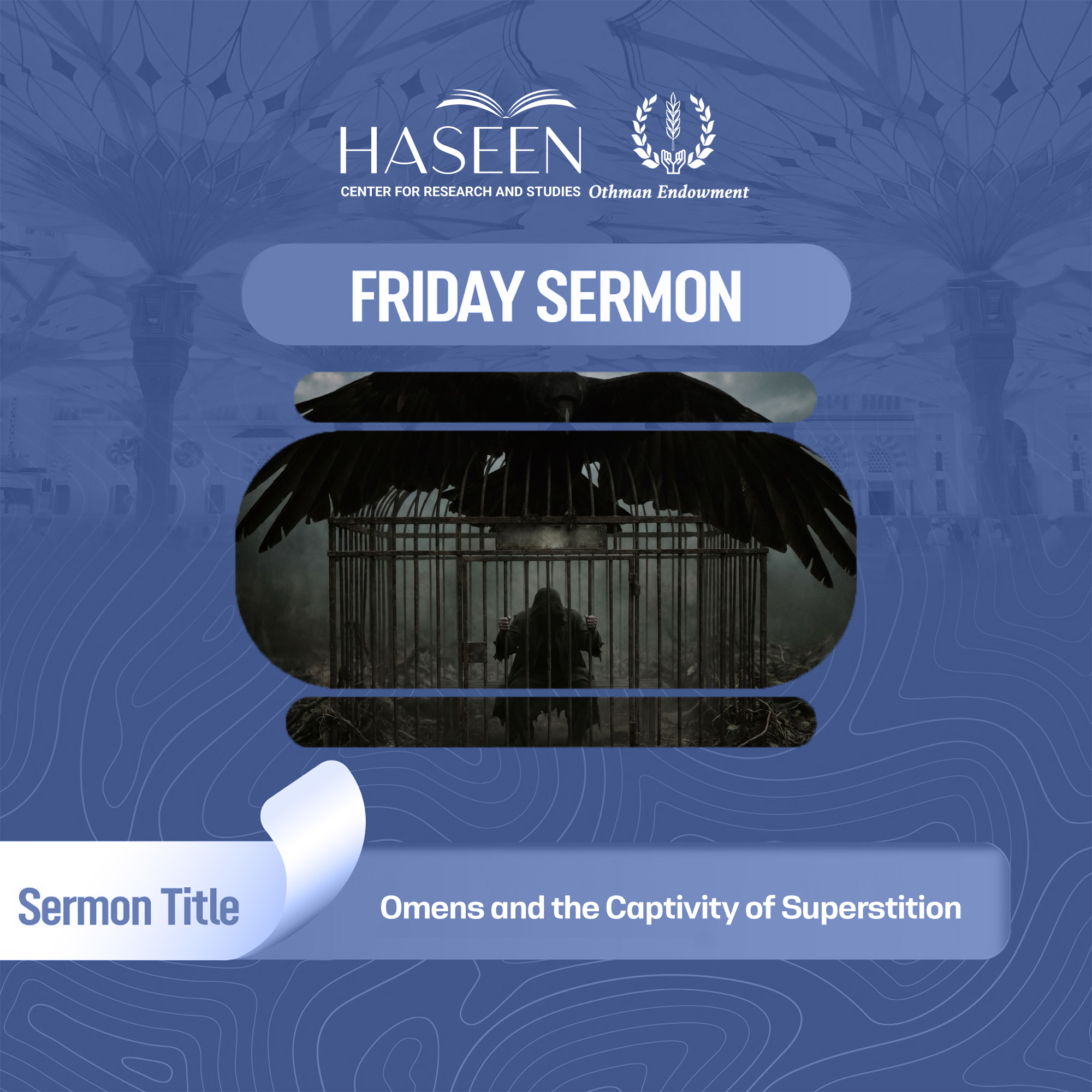
Sermon's Title: Omens and the Captivity of Superstition
Themes of the Sermon:
1- Omens are from the Practices of Jahiliyyah (Pre-Islamic Ignorance)
2- The Ruling on Omens and Their Reality
3- Istikhārah and Trust in Allah: The State of a Muslim
All praise belongs to Allah, who has brought us out of darkness into light through faith in Him, and has made the lives of the believers wholesome through His divine law, leaving them in happiness and joy. I bear witness that there is no deity worthy of worship except Allah alone, without any partner, and I bear witness that Muḥammad is His servant and Messenger. May Allah grant him abundant peace and blessings.
To proceed: Fear Allah, O servants of Allah, with true mindfulness and piety, and remain conscious of Him in secret and in public.
يَا أَيُّهَا الَّذِينَ آمَنُوا اتَّقُوا اللَّهَ حَقَّ تُقَاتِهِ وَلَا تَمُوتُنَّ إِلَّا وَأَنْتُمْ مُسْلِمُونَ
“O you who believe, fear Allah as He should be feared and do not die except as Muslims [in submission to Him].” [Sūrat Āl ʿImrān: 102].
Servants of Allah:
One day, Muʿāwiyah ibn al-Ḥakam as-Sulamī asked the Prophet ﷺ, saying: “O Messenger of Allah! I have only recently left Jahiliyyah (pre-Islamic ignorance) behind, and Allah has brought us Islam. Indeed, there are men among us who take omens.” The Prophet ﷺ replied: “That is something they find in their own breasts, so do not let it prevent you [from your plans].” Reported by Muslim.
Truly, by Allah, faith in Allah alone, without any partner, is life and light, while associating partners with Allah is death and darkness.
How wretched is that state of pre-Islamic ignorance which makes a human being a prisoner of delusion and superstition! And how could it be otherwise, when they have strayed far from Allah, the One, the Self-Sufficient?!
The people of Jahiliyyah used to draw omens—meaning they would seek bad luck—from the movements of birds. If one of them intended to do something, he would go to a bird and shoo it away. If it flew to the right, he would proceed with his need, happy and optimistic. But if it flew to the left, he would hold back and turn away, sad and despondent!
They also drew bad omens from their sounds; one of them would hear the cry of a crow and expect separation, or see a kite and anticipate death.
In fact, they even drew bad omens from days and months, expecting evil during the month of Ṣafar, and refusing to marry during the month of Shawwāl.
So when Islam came to bring humanity out of the darkness of polytheism and delusions, it abolished all of that, so that they would be servants only to Allah, who is unique in His sovereignty and planning.
The Prophet ﷺ said: “There is no contagious disease [spreading of its own accord], no bad omen (ṭiyarah), no owl [bringing a bad omen], and no superstition in the month of Ṣafar.” Reported by al-Bukhārī and Muslim.
The Prophet ﷺ also said: “The birds fly in accordance with divine decree.” Reported by Aḥmad.
“No bad omen” means there is no reality to what the people of Jahiliyyah believed regarding the relationship between birds, their movements, and divine destiny.
“No superstition in the month of Ṣafar” means the month of Ṣafar has no connection to good or evil.
Indeed, the Islamic creed is built upon the truth that creation and command belong to Allah alone. He alone directs all affairs without any partner, and He alone knows the unseen and ordains all destinies. Allah the Almighty said:
مَا أَصَابَ مِنْ مُصِيبَةٍ فِي الْأَرْضِ وَلَا فِي أَنْفُسِكُمْ إِلَّا فِي كِتَابٍ مِنْ قَبْلِ أَنْ نَبْرَأَهَا إِنَّ ذَلِكَ عَلَى اللَّهِ يَسِيرٌ * لِكَيْلَا تَأْسَوْا عَلَى مَا فَاتَكُمْ وَلَا تَفْرَحُوا بِمَا آتَاكُمْ وَاللَّهُ لَا يُحِبُّ كُلَّ مُخْتَالٍ فَخُورٍ
“No disaster strikes upon the earth or among yourselves except that it is in a register before We bring it into being - indeed that, for Allah, is easy. In order that you not despair over what has eluded you and not exult [in pride] over what He has given you. And Allah does not love every self-deluded and boastful person.” [Sūrat al-Ḥadīd: 22-23].
Servants of Allah:
Even though Allah removed the ways of Jahiliyyah and brought the light of Monotheism, the accursed Devil continuously beautifies for people many of the corrupt beliefs and actions that the people of Jahiliyyah held. Among these is taking bad omens and being superstitious. We still see some Muslims today who draw bad luck from certain days, months, or years. Among them are those who find bad omens in seeing crows or any black animal, and those who see bad luck in meeting people with illnesses or physical disabilities. All of this is from the remnants of Jahiliyyah that Islam abolished when the Prophet ﷺ said: “Lo! Everything from the matters of Jahiliyyah is placed under my feet [i.e., abolished].” Reported by Muslim.
The matter has reached such a point with some people that if they intend to do something, they open the Qur'an to a random page. If their eyes fall upon a verse mentioning Paradise, glad tidings, or victory, they feel optimistic and proceed. But if their eyes fall upon a verse of warning or mention of punishment, they become superstitious and hold back. Is this why, and in this manner, that the Qur'an was revealed?
Indeed, whoever single out Allah in His Lordship will have their heart attached to none but their Lord. They will not see anyone else possessing the power to bring benefit, nor anyone else who can remove harm and dispel evil. Thus, you will find them putting their complete trust in their Master, untouched by superstition and unbound by delusions; rather, they are free from the chains of polytheism and idols. Did our Lord not say:
قُلْ أَفَرَأَيْتُمْ مَا تَدْعُونَ مِنْ دُونِ اللَّهِ إِنْ أَرَادَنِيَ اللَّهُ بِضُرٍّ هَلْ هُنَّ كَاشِفَاتُ ضُرِّهِ أَوْ أَرَادَنِي بِرَحْمَةٍ هَلْ هُنَّ مُمْسِكَاتُ رَحْمَتِهِ قُلْ حَسْبِيَ اللَّهُ عَلَيْهِ يَتَوَكَّلُ الْمُتَوَكِّلُونَ
“Say, 'Then have you considered what you invoke besides Allah? If Allah intended me harm, are they removers of His harm; or if He intended me mercy, are they withholders of His mercy?' Say, 'Sufficient for me is Allah; upon Him [alone] rely those who rely.'” [Sūrat az-Zumar: 38].
The Prophet ﷺ said: “Taking omens is polytheism (shirk), taking omens is polytheism,” saying it three times. Ibn Masʿūd (may Allah be pleased with him)—the narrator of the ḥadīth—added: “And there is none of us except [that some of this thoughts enter his mind], but Allah removes it through putting trust in Him (tawakkul).” Reported by Abū Dāwūd.
The meaning of this is that taking omens (ṭiyarah) is a form of associating partners with Allah. For a person to believe that things which have no direct, physical cause-and-effect relationship—such as birds or months—have an influence in bringing benefit or warding off harm is a form of polytheism (shirk) against Allah the Almighty.
Allah has placed clear, physical causes in the things He willed for the occurrence of good or bad. Drinking water is a cause for quenching thirst, fire is a cause for burning, and medicine is a cause for healing. As for things that are not known to be a direct physical cause for good or evil, it is forbidden to believe in them or to treat them as causes; rather, doing so is one of the branches of shirk.
If a Muslim finds any of these thoughts of superstition in themselves, they should proceed while putting their complete trust in their Lord, just as He, the Almighty, said:
فَإِذَا عَزَمْتَ فَتَوَكَّلْ عَلَى اللَّهِ إِنَّ اللَّهَ يُحِبُّ الْمُتَوَكِّلِينَ
“And when you have decided, then rely upon Allah. Indeed, Allah loves those who rely [upon Him].” [Sūrat Āl ʿImrān: 159].
However, if that fear turns a person back from carrying out their intended plans, then they have fallen into associating partners with Allah.
The Prophet ﷺ said: “Whoever is turned back from his need by a bad omen has committed shirk.” The Companions asked, "O Messenger of Allah, what is the expiation for that?" He replied: “That one of them says: 'O Allah, there is no good except Your good, there is no omen except Your omen, and there is no deity worthy of worship besides You.'” Reported by Aḥmad.
“There is no good except Your good” is a creed that uproots all attachment to false causes that Allah has not made a source of good or evil, and it strips shirk and its chains from the hearts and necks.
ʿAbd Allah ibn ʿAbbās (may Allah be pleased with them both) was once among some people when a crow flew by, cawing. A man from among the people said, "Good! Good!" (seeking to ward off a bad omen). Ibn ʿAbbās replied to him: “There is neither good nor evil [associated with this crow].” Reported by ad-Dīnawarī.
A servant's certainty in the Lord's absolute uniqueness in His sovereignty and planning, and that He decrees nothing but good for His servants, makes them brave and courageous, putting their trust in Allah alone. For this reason, the qualities of the believers who will enter Paradise without any account or punishment—as the Prophet ﷺ informed us—are: “They did not use cauterization, they did not seek incantations (ruqyah), they did not take bad omens, and upon their Lord they put their trust.” Reported by al-Bukhārī and Muslim.
Servants of Allah:
Allah has narrated to us in His Book that when the past disbelieving nations rejected faith and Allah afflicted them with poverty and adversity, they said to their Messengers: "We see a bad omen in you," meaning we attribute our bad luck to you and your call. The Messengers replied to them that whatever evil befell them was only by Allah's permission and because of what their own hands had earned. He, Glory be to Him, said:
وَلَقَدْ أَخَذْنَا آلَ فِرْعَوْنَ بِالسِّنِينَ وَنَقْصٍ مِنَ الثَّمَرَاتِ لَعَلَّهُمْ يَذَّكَّرُونَ * فَإِذَا جَاءَتْهُمُ الْحَسَنَةُ قَالُوا لَنَا هَذِهِ وَإِنْ تُصِبْهُمْ سَيِّئَةٌ يَطَّيَّرُوا بِمُوسَى وَمَنْ مَعَهُ أَلَا إِنَّمَا طَائِرُهُمْ عِنْدَ اللَّهِ وَلَكِنَّ أَكْثَرَهُمْ لَا يَعْلَمُونَ
“And We certainly seized the people of Pharaoh with years of famine and deficiency in fruits that perhaps they would be reminded. But when good came to them, they said, 'This is for us.' And if a bad condition struck them, they saw an evil omen in Moses and those with him. Unquestionably, their fortune is with Allah, but most of them do not know.” [Sūrat al-Aʿrāf: 130-131].
“their fortune is with Allah” means that whatever good or evil they experience is from Allah alone; He is the One who decreed it as a trial and a punishment. And He, the Almighty, said regarding the companions of the township:
قَالُوا إِنَّا تَطَيَّرْنَا بِكُمْ لَئِنْ لَمْ تَنْتَهُوا لَنَرْجُمَنَّكُمْ وَلَيَمَسَّنَّكُمْ مِنَّا عَذَابٌ أَلِيمٌ * قَالُوا طَائِرُكُمْ مَعَكُمْ أَئِنْ ذُكِّرْتُمْ بَلْ أَنْتُمْ قَوْمٌ مُسْرِفُونَ
“They said, 'Indeed, we consider you a bad omen. If you do not desist, we will surely stone you, and there will surely touch you from us a painful punishment.' They said, 'Your omen is with yourselves! Is it because you were reminded? Rather, you are a transgressing people.'” [Sūrat Yāsīn: 18-19].
The meaning of “Your omen is with yourselves” is: whatever evil and harm has befallen you, its cause is your own disobedience to the Messengers of Allah.
Therefore, if good befalls a Muslim, they must praise Allah, and if harm befalls them, they must blame themselves, for it is due to some of what their own hands have earned. They must then seek forgiveness and repent, just as He, the Almighty, said:
مَا أَصَابَكَ مِنْ حَسَنَةٍ فَمِنَ اللَّهِ وَمَا أَصَابَكَ مِنْ سَيِّئَةٍ فَمِنْ نَفْسِكَ
“What comes to you of good is from Allah, but what comes to you of evil, [O man], is from yourself.” [Sūrat an-Nisāʾ: 79].
Servants of Allah:
Our religion is a religion of optimism and spreading hope; therefore, the Prophet ﷺ used to love good words.
He ﷺ said: “There is no contagious disease [spreading of its own accord] and no bad omen, and I like good optimism (al-faʾl): a kind word.” Reported by al-Bukhārī and Muslim.
Ibn ʿAbbās (may Allah be pleased with them both) said: “The Messenger of Allah ﷺ used to look for positive signs, he did not take bad omens, and he loved good, beautiful names.” Reported by Aḥmad.
This is how Islam is the religion of natural inclination (fiṭrah). Sound souls are pleased with good words that spread hope and encourage the soul to take action and work. However, this is on the condition that a person does not make their actions entirely dependent on this—such that they only move when they hear a good word and become despondent when they do not. For all good is from Allah and returns to Him.
May Allah bless me and you through the Great Qur'an, and benefit me and you through the verses and wise reminders it contains. I seek Allah's forgiveness for myself and for you, so seek His forgiveness; indeed, He is the All-Forgiving, the Most Merciful.
The Second Sermon:
All praise belongs to Allah, and may peace and blessings be upon the Messenger of Allah, his family, his companions, and those who follow him. To proceed:
Jābir ibn ʿAbd Allah (may Allah be pleased with them both) said: “The Messenger of Allah ﷺ used to teach us the prayer of seeking guidance (Istikhārah) in all matters, just as he would teach us a chapter (Sūrah) of the Qur'an. He would say: 'If any of you intends to do something, let him pray two units of non-obligatory prayer, then say: O Allah, I seek Your guidance through Your knowledge, I seek strength through Your power, and I ask You of Your great bounty. For indeed, You have power and I do not, You know and I do not, and You are the Knower of the unseen. O Allah, if You know that this matter is good for me in my religion, my livelihood, and the outcome of my affair—or he said: in this life and the hereafter—then decree it for me, make it easy for me, and then bless me in it. And if You know that this matter is bad for me in my religion, my livelihood, and the outcome of my affair—or he said: in this life and the hereafter—then turn it away from me and turn me away from it, and decree for me what is good wherever it may be, and then make me pleased with it.' He added: 'And then he should name his need.'” Reported by al-Bukhārī and Muslim.
Indeed, a Muslim stands before their Lord, delegating their affairs to Him, freeing themselves from their own knowledge, power, and strength. They derive guidance and correctness from their Lord to whatever contains good, and they ask their Master to turn away evil from them. This is the light of Monotheism (Tawḥīd) which disperses the darkness of polytheism and rival partners.
O Allah, we seek refuge in You from knowingly associating anything with You, and we seek Your forgiveness for what we do not know.
O Allah, aid us and do not aid others against us; grant us victory and do not grant victory over us; plan for us and do not plan against us; and grant us victory over those who transgress against us.
O Allah, grant us safety in our homelands, rectify our leaders and those in authority over us, and place our leadership under the care of those who fear You, remain mindful of You, and seek Your pleasure.
O Allah, be with our oppressed brothers and sisters in Gaza and everywhere, and decree for them a near victory and relief.
Servants of Allah: Remember Allah with much remembrance, and glorify Him morning and afternoon. And our final call is: All praise belongs to Allah, Lord of the Worlds.