
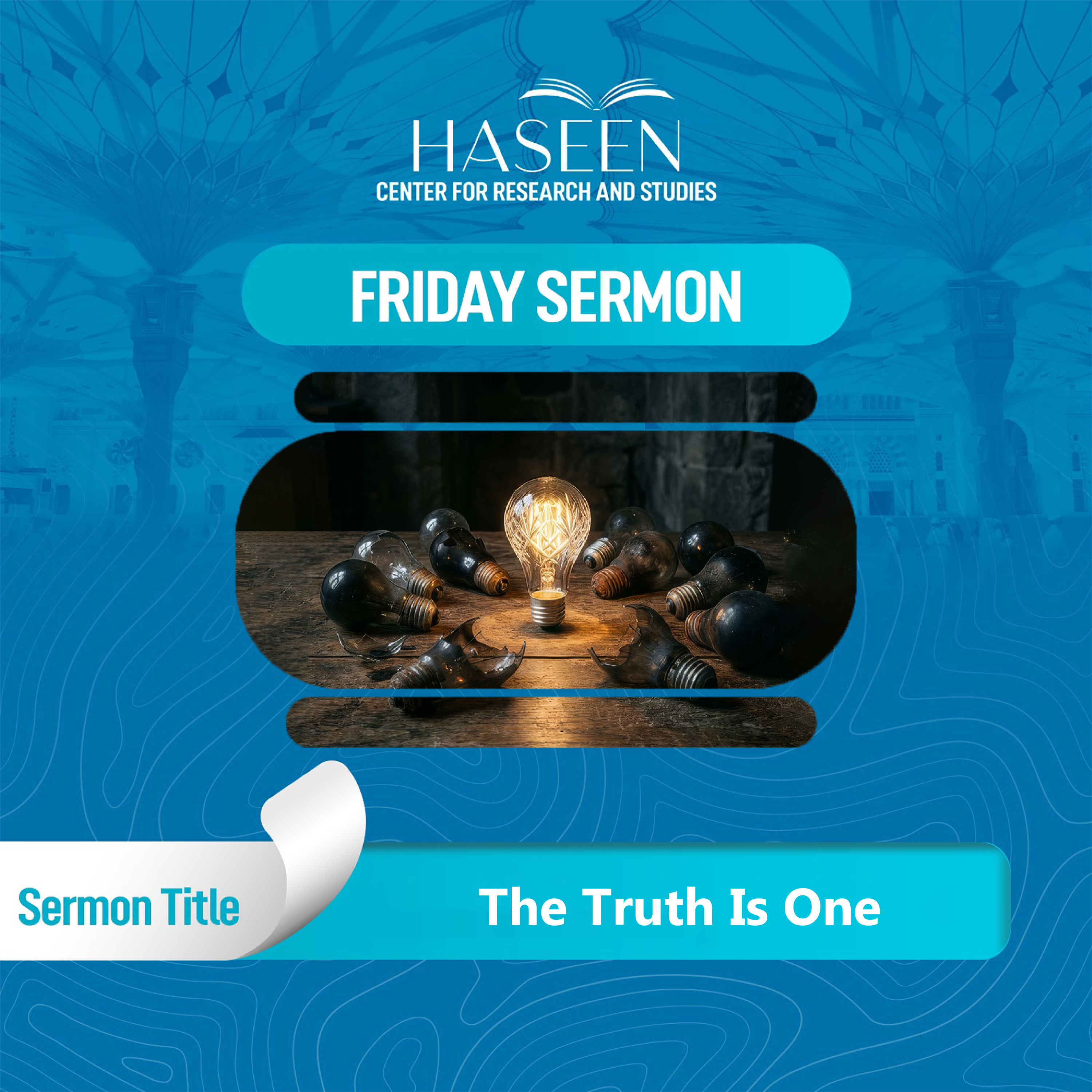
Sermon's Title: The Truth Is One
Themes of the Sermon:
1- The nature of truth and its source
2- The claim of “relative truth” and the clarification of its falsehood.
3- Human reasoning where differences of opinion are accepted.
All praise belongs to Allah, the Clear Truth, who establishes the truth and nullifies falsehood, even if the criminals dislike it. I bear witness that there is no deity worthy of worship except Allah alone, without partner, and I bear witness that Muḥammad is His servant and Messenger. May Allah send abundant peace and blessings upon him.
To proceed:
Fear Allah, O servants of Allah, with true Taqwā. Be mindful of Him in private and in secret. Allah says:
يَا أَيُّهَا الَّذِينَ آمَنُوا اتَّقُوا اللَّهَ حَقَّ تُقَاتِهِ وَلَا تَمُوتُنَّ إِلَّا وَأَنْتُمْ مُسْلِمٌونَ
“O you who believe, fear Allah as He truly deserves to be feared, and do not die except in a state of Islam.” [Sūrat Āl ʿImrān: 102]
Servants of Allah,
A great and powerful scene—Allah devoted an entire sūrah to it. It is the scene of the People of the Trench, where a tyrant king claimed to be a god besides Allah. He forced people to worship him and even falsely claimed lordship for himself.
But Allah willed to bring that nation out from the falsehood of disbelief and shirk into Tawḥīd and truth. When the tyrant’s arguments collapsed and his falsehood became clear, he lit great fires and ordered the believers to be burned.
At the end of this scene, as the believers were thrown into the fire one after another, our Prophet ﷺ told us about a woman among them. He said: “She came with her child, and she hesitated to fall into the fire. The child said to her: ‘O my mother, be patient, for you are upon the truth.” Narrated by Muslim.
“Be patient, for you are upon the truth.”
There are only two paths: the truth and its people, and falsehood and its people. It is a battle that continues as long as night and day alternate. Allah says:
الَّذِينَ كَفَرُوا وَصَدُّوا عَنْ سَبِيلِ اللَّهِ أَضَلَّ أَعْمَالَهُمْ * وَالَّذِينَ آمَنُوا وَعَمِلُوا الصَّالِحَاتِ وَآمَنُوا بِمَا نُزِّلَ عَلَى مُحَمَّدٍ وَهُوَ الْحَقُّ مِنْ رَبِّهِمْ كَفَّرَ عَنْهُمْ سَيِّئَاتِهِمْ وَأَصْلَحَ بَالَهُمْ * ذَلِكَ بِأَنَّ الَّذِينَ كَفَرُوا اتَّبَعُوا الْبَاطِلَ وَأَنَّ الَّذِينَ آمَنُوا اتَّبَعُوا الْحَقَّ مِنْ رَبِّهِمْ كَذَلِكَ يَضْرِبُ اللَّهُ لِلنَّاسِ أَمْثَالَهُمْ
“Those who disbelieve and turn others away from the path of Allah—He renders their deeds lost. But those who believe and do righteous deeds and believe in what was revealed to Muḥammad—and it is the truth from their Lord—He removes their sins and corrects their condition. That is because those who disbelieve follow falsehood, and those who believe follow the truth from their Lord. Thus Allah presents examples for the people.” [Sūrat Muḥammad: 1–3]
You have heard the path and the outcome: whoever follows the truth will have his religion and worldly life set right, and whoever follows falsehood will end in loss and ruin.
Servants of Allah,
Those who promote falsehood have sought, by every means, to spread it and to erase the truth. Among the most dangerous of these means is making falsehood appear acceptable—presenting it as something normal and reasonable.
They have many methods, but among the most dangerous, both in the past and in our time, and among the most widespread, is what they call “the relativity of truth.”
Is this claim true or false? Come, let us distinguish truth from falsehood.
First: What is truth? What is its source? And how do we recognize it?
Truth is that which is firm and real, something that truly exists in reality—true, not false. It is that which remains and benefits, that which does not vanish or fade away.
Falsehood, on the other hand, is that which is fabricated and distorted, which has no real existence. Its end is collapse, disappearance, and ruin.
Every claim—whether it is a belief, a ruling, a religion, an idea, a methodology, or a path—is either truth or falsehood.
In this world, there is a true God, and everything besides Him is false. There is the religion of truth, and everything besides it is false. There is the law of truth, and everything besides it is false. There is the path of truth, and everything besides it is false.
As for the truth—it is Allah, the Clear Truth. He speaks the truth, narrates the truth, and judges with truth. All His words and actions are true and just. He guides to the truth. He created the heavens and the earth with truth. He revealed His Book with truth. To Him belongs the call of truth. He casts truth against falsehood, crushing it until it vanishes. Allah says:
فَتَوَكَّلْ عَلَى اللَّهِ إِنَّكَ عَلَى الْحَقِّ الْمُبِينِ
“So rely upon Allah; indeed, you are upon the clear truth.” [Sūrat al-Naml: 79]
He also says:
ذَلِكَ بِأَنَّ اللَّهَ هُوَ الْحَقُّ وَأَنَّ مَا يَدْعُونَ مِنْ دُونِهِ هُوَ الْبَاطِلُ وَأَنَّ اللَّهَ هُوَ الْعَلِيُّ الْكَبِيرُ
“That is because Allah is the Truth, and what they call upon besides Him is falsehood, and Allah is the Most High, the Most Great.” [Sūrat al-Ḥajj: 62]
He says:
قُلِ اللَّهُ يَهْدِي لِلْحَقِّ
“Say: Allah guides to the truth.” [Sūrat Yūnus: 35]
And He says:
قُلْ إِنَّ رَبِّي يَقْذِفُ بِالْحَقِّ عَلَّامُ الْغُيُوبِ
“Say: Indeed, my Lord casts the truth—Knower of the unseen.” [Sūrat Sabaʾ: 48]
And He says:
هُوَ الَّذِي أَرْسَلَ رَسُولَهُ بِالْهُدَى وَدِينِ الْحَقِّ لِيُظْهِرَهُ عَلَى الدِّينِ كُلِّهِ وَلَوْ كَرِهَ الْمُشْرِكُونَ
“It is He who sent His Messenger with guidance and the religion of truth to make it prevail over all religions, even if the polytheists dislike it.” [Sūrat al-Tawbah: 33]
The Prophet ﷺ used to say in praise of his Lord when he stood at night: “To You belongs all praise. You are the Truth. Your promise is true. Meeting You is true. Your word is true. Paradise is true. Hellfire is true. The prophets are true. Muḥammad ﷺ is true. And the Hour is true.” Narrated by al-Bukhārī and Muslim.
The Book of Allah is entirely truth. Falsehood cannot approach it—neither from before it nor from behind it. Allah says:
وَإِنَّهُ لَكِتَابٌ عَزِيزٌ * لَا يَأْتِيهِ الْبَاطِلُ مِنْ بَيْنِ يَدَيْهِ وَلَا مِنْ خَلْفِهِ تَنْزِيلٌ مِنْ حَكِيمٍ حَمِيدٍ
“Indeed, it is a mighty Book. Falsehood cannot approach it from before it or from behind it. It is a revelation from One who is Wise and Praiseworthy.” [Sūrat Fuṣṣilat: 41–42]
He also says:
وَبِالْحَقِّ أَنْزَلْنَاهُ وَبِالْحَقِّ نَزَلَ وَمَا أَرْسَلْنَاكَ إِلَّا مُبَشِّرًا وَنَذِيرًا
“With truth We have sent it down, and with truth it has descended. And We did not send you except as a bringer of good news and a warner.” [Sūrat al-Isrāʾ: 105]
Everything brought by the Messenger ﷺ is truth. He does not speak from desire. Allah says:
يَا أَيُّهَا النَّاسُ قَدْ جَاءَكُمُ الرَّسُولُ بِالْحَقِّ مِنْ رَبِّكُمْ
“O mankind, the Messenger has come to you with the truth from your Lord.” [Sūrat al-Nisāʾ: 170]
ʿAbd Allāh ibn ʿAmr ibn al-ʿĀṣ, may Allah be pleased with them both, said:
“I used to write down everything I heard from the Messenger of Allah ﷺ, intending to memorize it. Quraysh forbade me and said: ‘Do you write everything you hear while the Messenger of Allah ﷺ is a human being who speaks in anger and in pleasure?’ So I stopped writing. Then I mentioned that to the Messenger of Allah ﷺ, and he pointed to his mouth with his finger and said: ‘Write, for by the One in whose hand is my soul, nothing comes out of it except the truth.” Narrated by Abū Dāwūd.
Servants of Allah,
Allah has made His Book and the Sunnah (the teachings and example) of His Prophet ﷺ a criterion that distinguishes between truth and falsehood, between justice and oppression, between good and evil, between what is pure and what is corrupt, and between what is right and what is wrong.
Yet among people are groups who denied Allah, His divinity, and His authority. They elevated the human being instead of Allah, making human reason and thought their ultimate standard—the axis around which they revolve.
When they saw that human opinions differ and vary, they said: “Truth is relative.” Meaning: what you see as truth is not absolute truth—it is only true relative to you. And what someone else sees as truth is true relative to him.
Thus, truth is no longer something firm and established, but becomes fluid and shapeless. Reality itself becomes scattered and meaningless—indeed, they claim that there is no truth at all.
There is no longer truth or falsehood in matters of divinity, rulings, laws, methods, ideas, morals, or values. Everything becomes relative.
Servants of Allah,
It is astonishing in our time to see those who claim that all truths are relative, and that there is no absolute truth at all. They do not realize that such a person contradicts himself and invalidates his own claim.
If we ask him: “Is your statement—that there is no absolute truth—an absolute truth?” If he says “Yes,” then he has contradicted himself and affirmed that absolute truths do exist, and his entire position collapses. If he says “No,” then his statement itself falls apart and is no longer binding on anyone.
Furthermore, if all truths were relative and fluid, then contradictions and opposites would be equal. This is clearly false by basic reason.
Are existence and non-existence the same?
Are purity and impurity the same?
Are justice and oppression, good and evil, kindness and aggression the same?
O people of sound minds,
Is the existence of the heavens and the earth, the sun and the moon, an absolute reality or something relative? What if a person claimed that the existence of these things—or that fire burns—is merely a relative truth that differs from one person to another?
Would it not be obvious to everyone that such a person has lost his mind?
Just as there are physical truths in this universe that do not change, there are also moral truths that do not change. Allah has placed within people a natural disposition (fiṭrah—a built-in sense of right and wrong) that recognizes them.
What if someone attacked an innocent person and killed him for pleasure? Or stole people’s wealth and destroyed it, claiming that he was deprived? Could any rational person—or any judge—say that such crimes are merely relative matters with different perspectives?
There is an immense number of truths that human beings recognize through their senses and their natural disposition—truths about which no two rational people would disagree.
Something does not become true simply because someone believes it to be true, nor does it become false because someone claims it is false. A thing is true because it exists, is established, and is supported by evidence—whether people accept it or reject it. Allah says:
وَلَوِ اتَّبَعَ الْحَقُّ أَهْوَاءَهُمْ لَفَسَدَتِ السَّمَاوَاتُ وَالْأَرْضُ وَمَنْ فِيهِنَّ
“If the truth had followed their desires, the heavens and the earth and all within them would have been corrupted.” [Sūrat al-Muʾminūn: 71]
Because Allah created mankind, and He knows their weakness, and He knows that differences and the confusion of desires will occur among them, He did not leave them to the relativity of human reasoning or the chaos of opinions.
Rather, He revealed to them the written revelation—truth that is protected from error—so that it becomes a scale by which they measure their actions and a criterion by which they distinguish between truth and falsehood. Allah says:
كَانَ النَّاسُ أُمَّةً وَاحِدَةً فَبَعَثَ اللَّهُ النَّبِيِّينَ مُبَشِّرِينَ وَمُنْذِرِينَ وَأَنْزَلَ مَعَهُمُ الْكِتَابَ بِالْحَقِّ لِيَحْكُمَ بَيْنَ النَّاسِ فِيمَا اخْتَلَفُوا فِيهِ وَمَا اخْتَلَفَ فِيهِ إِلَّا الَّذِينَ أُوتُوهُ مِنْ بَعْدِ مَا جَاءَتْهُمُ الْبَيِّنَاتُ بَغْيًا بَيْنَهُمْ فَهَدَى اللَّهُ الَّذِينَ آمَنُوا لِمَا اخْتَلَفُوا فِيهِ مِنَ الْحَقِّ بِإِذْنِهِ وَاللَّهُ يَهْدِي مَنْ يَشَاءُ إِلَى صِرَاطٍ مُسْتَقِيمٍ
“Mankind was one community, then Allah sent the prophets as bringers of good news and warners, and He revealed with them the Book in truth so that it might judge between people concerning what they differed about. And none differed over it except those who were given it after clear proofs had come to them—out of injustice among themselves. Then Allah guided those who believed to the truth concerning that over which they differed, by His permission. And Allah guides whom He wills to a straight path.” [Sūrat al-Baqarah: 213]
Allah has honored this Ummah with a pure source that has not been corrupted by the distortions of the corrupt. He says:
وَمِمَّنْ خَلَقْنَا أُمَّةٌ يَهْدُونَ بِالْحَقِّ وَبِهِ يَعْدِلُونَ
“And among those We created is a community that guides by the truth and judges with it.” [Sūrat al-Aʿrāf: 181]
There is no guidance and no justice except through the truth.
These people only disliked the truth because it stood between them and their desires—it prevented them from pursuing corruption, injustice, and wrongdoing. So they invented this false claim in order to make disbelief, immorality, deviance, aggression, and oppression seem like relative matters. Our Lord says about them:
لَقَدْ جِئْنَاكُمْ بِالْحَقِّ وَلَكِنَّ أَكْثَرَكُمْ لِلْحَقِّ كَارِهُونَ
“We brought you the truth, but most of you dislike the truth.” [Sūrat al-Zukhruf: 78]
May Allah bless me and you through the Great Qurʾān, and may He benefit me and you through its verses and wise reminder. I seek forgiveness from Allah for myself and for you, so seek His forgiveness. Indeed, He is the Most Forgiving, the Most Merciful.
The Second Sermon:
All praise belongs to Allah. May peace and blessings be upon the Messenger of Allah, upon his family, his companions, and those who follow him.
Servants of Allah,
Alongside the clear and definitive matters that do not accept change or relativity, it cannot be denied that in other matters there is a natural space for differences in reasoning and diversity in understanding. In such matters, people of sound intellect accept differing viewpoints when they are built upon proper understanding and sound evidence.
By His mercy, Allah has allowed room in some rulings for scholarly reasoning. Scholars may differ in how they understand the evidence. A scholar’s opinion may be correct yet still carry the possibility of error, and he excuses those who differ from him.
However, it is a mistake to confuse matters. This acceptable form of disagreement applies only to the people of knowledge, and only in certain details and secondary issues—not in the foundations of the religion, its clear and decisive matters, and its firm principles, which do not accept compromise or change, such as matters of creed, the obligation of prayer, and the prohibition of ribā and immoral acts.
We have an example in the companions of the Messenger of Allah ﷺ. When the Prophet ﷺ returned from the battle of al-Aḥzāb, he said to them: “None of you should pray ʿAṣr except in Banū Qurayẓah.”
Some of them reached the time of ʿAṣr while still on the way. Some said, “We will not pray until we reach it,” while others said, “We will pray, for that was not what was intended from us.” The matter was later mentioned to the Prophet ﷺ, and he did not criticize either group. Narrated by al-Bukhārī and Muslim.
This difference among the companions, may Allah be pleased with them, was acceptable because the words of the Prophet ﷺ could be understood in more than one way. In this manner, the Sharīʿah (Islamic law) allows room for scholarly differences in matters of ijtihād—issues understood by qualified scholars—while remaining firm and unshakable in its core principles and major truths.
O Allah, grant victory to Islam and honor the Muslims. Destroy the disbelieving criminals. O Allah, send tranquility into the hearts of the believers. Raise high the banner of the religion by Your power, O Most Strong, O Most Firm.
O Allah, restrain the hands of the oppressors from us. Grant us from Yourself a protector and grant us from Yourself a helper.
O Allah, grant us security in our homelands. Rectify our leaders and those in authority over us. Place our leadership in the hands of those who fear You, remain mindful of You, and follow what pleases You.
Our Lord, grant us good in this world and good in the Hereafter, and protect us from the punishment of the Fire.